From a time consuming development process to a single efficient codebase
- A single codebase for all platforms
- Rapid validation through a Proof of Concept
- Reliable development partner with media expertise

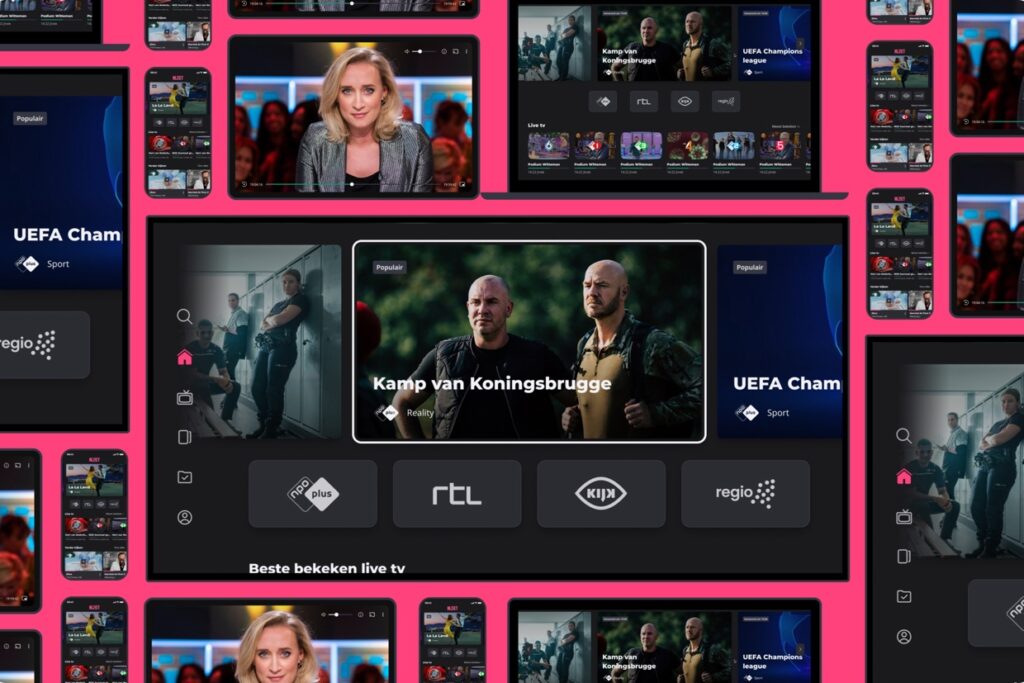
Maintaining multiple native applications simultaneously for iOS, Android, web, and smart TV platforms is costly and complex. NLZIET, the streaming service offering content from NPO, RTL, and Talpa, faced a key question: can React Native multiplatform development simplify the development process without compromising performance? Through a clearly defined proof of concept, NetRom Software demonstrated that it is possible to develop applications for all platforms using a single codebase.
Developing and maintaining separate applications for different platforms requires significant time and specialized resources. Sander Kouwenhoven, CTO at NLZIET, explains: “For each platform, we would need to hire one or two dedicated specialist developers. That model is too vulnerable and too expensive.” This approach leads to high costs, longer time to market, and complex coordination across teams.
One potential solution was React Native. This open-source framework makes it possible to build applications for multiple platforms from a single codebase. Kouwenhoven wanted to assess whether this technology could be effectively applied in the domain of video applications. The key question was whether React Native could meet the stringent requirements of a streaming platform such as NLZIET.

NLZIET deliberately chose to collaborate with NetRom. “The decision to work with NetRom Software was partly based on previous positive experiences and competitive hourly rates,” Kouwenhoven explains. “In addition, the clearly defined and standalone nature of the assignment made it a suitable test case to evaluate whether nearshoring could be a viable solution.”
The approach was pragmatic: a strict proof of concept with clearly defined objectives and a fixed budget. The goal was to technically demonstrate that React Native could meet the demanding requirements of a streaming platform.
The proof of concept was required to perform at the same level as the existing native applications. The budget was strictly defined – any overrun would result in termination of the project. A predefined exit strategy was also agreed upon in case the technology or the team failed to meet expectations.
The collaboration was structured as a blended team: three NLZIET team members worked alongside two developers and one tester from NetRom. A critical element of the engagement was the in-person kickoff at the NetRom Campus in Romania, where extensive knowledge was exchanged among all team members over several days.
“NetRom Software has validated a theory for NLZIET that is decisive for the technology choices we will be making in the coming years.”
SANDER KOUWENHOVEN, CTO AT NLZIET
In less than three months, the team delivered an application that met all defined technical requirements. The project was completed within budget, and the app performs at the same level as the existing native applications. A single codebase validated the feasibility of supporting iOS, Android, web, and TV platforms.
“With this, NetRom Software has validated a theory for NLZIET that is decisive for the technology choices we will be making in the coming years,” Kouwenhoven states. “We now know that React Native is suitable for our platform. We also understand what is required to make the transition.”
The proof of concept provided the strategic clarity NLZIET needed. The structured approach helped prevent costly missteps: “If the outcome had shown that React Native was not a suitable solution, we would have continued with our existing technology stack.”
The PoC delivered more than technical validation. NLZIET can now make informed decisions about its platform strategy. A single codebase enables lower development and maintenance costs, and new features can be rolled out simultaneously across all platforms.
Would you like to learn more about how NetRom Software addressed the technological challenges of NLZIET’s multi-platform streaming environment?