“You don’t get what you want, but what you need”
December 19, 2025 13 minutes

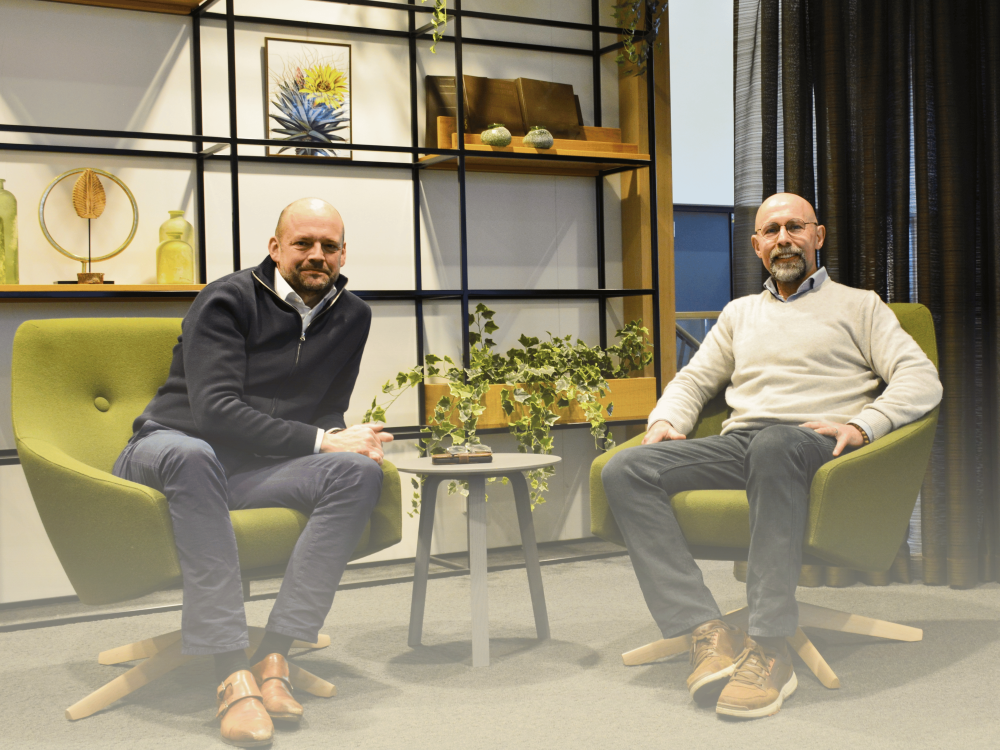
What is the secret to a successful software partnership? In this joint interview, Jaap Merkus, CEO of NetRom Software, and Giancarlo Billault-Scaramelli, organisational advisor and former CIO of Transdev Netherlands, share their perspectives. Drawing on their respective expertise and experience, they explain how to create value together that goes beyond frameworks and features, and what it takes to evolve from a traditional supplier relationship into a partnership built on trust.
What does “creating value together” mean for a software development partner in a strategic role? For Jaap Merkus, value creation starts with a deep understanding of what an organisation is ultimately trying to achieve. “Of course, there are documented functional and technical requirements that need to be delivered,” he explains. “But those only gain meaning when they align seamlessly with the value for the business and its customers. When you can jointly define and understand that value, you start to create truly unique value.”
This perspective resonates strongly with Giancarlo. As former CIO of Transdev Netherlands, he worked closely for many years with NetRom’s development teams. Today, as an organisational advisor, he supports companies in managing cultural change. He stresses that the responsibility for defining value lies with the client organisation. “You can build a solution that is technically flawless, yet does nothing to improve the customer’s experience,” he cautions. “That is why I always tell development teams: Don’t aim for the best of the best, but develop a solution that genuinely improves the customer’s life.’”
“With a clearly defined assignment, the relationship with a supplier is often short-term,” Jaap explains. “Something needs to be built based on strict specifications, and once that work is completed, both parties go their separate ways. A partner, on the other hand, is there for the long term. From a partner, you expect active involvement, honest feedback, and sometimes even the willingness to challenge your decisions.”
He continues: “In partnerships, not everything is captured in writing. When you consistently go beyond what is contractually defined, that is when you truly become partners.”
Giancarlo refers to the development of the Boeing 747 as an instructive example. “The person responsible for the project did something remarkable. Instead of starting with a single ‘master design’, he began by asking a question to pilots, baggage handlers, cleaners, and cabin crew: ‘What does the perfect aircraft look like from your perspective?’ Input from these different viewpoints created a much more complete picture, which then served as the basis for further work. You cannot satisfy every individual requirement, so prioritisation is essential. You start with what meets the needs of 80% of the people.”
Jaap adds: “In the past, the approach was to build one master design, deliver a final product a year and a half later, and only then realise: ‘This may be what I originally wanted, but it is not what I need now.’ That is why we work with clients using an agile approach, delivering in sprints. You break the overall scope into smaller parts, so that after each short iteration you can jointly assess whether what has been built is truly what is needed.”
“A client can hand a development partner a list of requirements and say: this is what you need to do,” Giancarlo explains. “Once that list has been completed, the assignment is finished. That is a top-down way of working. But you can also say to a partner: this is what we want to achieve, and this is the value we want to create for our customers. Think along with us – are these really the right requirements? The value you create in that scenario is often greater than with a top-down assignment that lacks context.”
Giancarlo reflects on his time as CIO at Transdev Netherlands. “I clearly remember how my team responded when they were challenged by the partner – and that partner was NetRom Software. My team believed option A was the better choice, while NetRom advised pursuing option B. Choosing B demonstrated that my team had developed trust in NetRom. That was a strong signal.”
He explains that trust does not emerge from simply ticking off a checklist. “It is a feeling that develops over time through collaboration – when you reach a point where you know you can rely on the other party. My advice is to look at your own team. How do they respond to working with the development team? Is the collaboration open and relaxed, or do they react cautiously to the partner’s proposals?”
Jaap responds without hesitation: “At a very fundamental level. If you do not communicate clearly and completely, your partner may feel they are not hearing the full story. Open communication means explicitly addressing what is going on. Even when you do not have an answer, you should say so – this shows that you have looked into the matter thoroughly. When you communicate in this way, the other party gets the sense that the conversation is authentic and that they are seeing the full picture.”
“I never look for a partner who simply agrees with everything,” Giancarlo states firmly. “I want a partner who challenges me and asks whether this is truly the best choice for the organisation. Simply saying yes to a client is not constructive.”
He adds that this requires trust. “If a partner carries out an assignment solely for financial reasons, they will remain silent because they are afraid of losing the client. For a successful collaboration, a development partner must be genuinely interested in the client’s success.”
Jaap smiles. “We simply enjoy working with a client over a longer period of time. We do not make it more complicated than it needs to be. Long-term collaboration is part of NetRom’s DNA. When you support a client over an extended period, you can see the impact of what you have built yourself. The assignment no longer feels like ‘I need to deliver something’, but develops into genuine involvement. When you enjoy what you do, you also become better at it. You get to know the client’s organisation increasingly well, which enables you to support it more effectively.”
Jaap explains: “What appealed to me when I started working at NetRom is that we sometimes also say no to clients. That comes from a shared view on partnerships. To be a strong long-term partner, you need well-trained developers. Developers who also enjoy working with a client over an extended period.”
He acknowledges that this sometimes requires difficult decisions. “In some cases, that means saying no to an assignment as a whole or to specific parts of it. That happens when we know the work genuinely does not suit our people. For new clients, our perspective can take some getting used to. They may wonder whether they are still considered important. It is not an either-or situation, but a both-and approach. Putting employees first consistently translates into quality, experience, continuity, and reliability, and through that, you also put the customer first.”
Giancarlo fully agrees. “If I have to set priorities, it is always people first. Technology can always be bought or built. The value for clients is the combination of technology, vision, and people.”
He continues: “You cannot buy people. You have to be able to select them, retain them, protect them, and help them grow. I always tell my managers: hire the person, not the role. If someone has excellent technical skills but is unpleasant to work with, that is not a fit for me. The damage such a person can cause outweighs the benefits of their technical expertise.”

Jaap identifies three key elements. “A combination of strong technical skills that are continuously refined, a genuine passion for the profession and the ambition to excel in it, and building long-term partnerships together with colleagues who enjoy working together. When those three elements come together, there is a great deal of intrinsic motivation to create meaningful solutions and to support one another, in close collaboration with the client.”
He adds that there is more. “Our field evolves so rapidly that it is almost impossible for a single Agile Scrum team of four, five, or six people to possess all the required knowledge. What we offer our clients is indirect access, through their team, to nearly 500 professionals with expertise in tooling, domain knowledge, and process knowledge. We operate from our state-of-the-art NetRom Campus, where teams collaborate efficiently and effectively. Our expert groups focus on knowledge sharing, and supporting one another is an integral part of our company culture.”
Giancarlo is clear on this point. “Continuity is essential for any organisation. Starting a new collaboration every time does not lead to productivity. Culture matters because it provides a foundation for effective cooperation. When there is a cultural fit with the development partner, it becomes much easier to navigate challenging situations together.”
He sees a direct relationship between the two. “Continuity and culture reinforce each other. To retain clients over the long term, you need a collaborative culture, one that is customer-focused and consistently delivers on its commitments.”
“Clarity and transparency,” Jaap responds. “You encourage ownership by clearly stating: this is what you are responsible for. But it goes beyond that. Ownership also means actively involving the perspectives and expertise of others and continuously asking for their input. It also requires creating room to make mistakes and making it clear that this is acceptable, as long as people learn, invest effort, and support one another. When work is being done, mistakes will inevitably happen. At the NetRom Academy, we focus not only on technical competencies, but also on team roles and leadership, assertiveness, and purposeful communication. This ensures that the development of hard skills and soft skills among our engineers progresses in parallel.”
Giancarlo agrees. “To make ownership possible, a psychologically safe culture is essential. That is a fundamental prerequisite. If developers are afraid of making mistakes, they will not take risks, and that directly hinders innovation.”
He adds: “Ownership is only possible when people dare to take risks. If during development you only choose solutions that are one hundred percent certain, you function like a machine rather than as a human being. By occasionally taking risks, you make progress and can fundamentally change the trajectory of an organisation.”

Jaap looks ahead with enthusiasm, but also with nuance. “At this moment, AI is a fascinating part of our work. At NetRom, we have been actively exploring these developments for several years, and we aim to be at the forefront.”
He shares NetRom’s experience. “We started working with AI actively around fifteen years ago, primarily by applying machine learning algorithms in customer applications. In recent years, this has accelerated significantly due to developments in large language models. For the past three years, AI has also been applied within the software development process itself, with the aim of increasing productivity, shortening feedback cycles, and improving quality. In some areas, this is already proving effective, but there is still progress to be made, and the role of the engineer in the loop remains crucial.”
He continues: “You need to be able to trust that the output generated by AI is correct, and at present that is not always the case. AI can sometimes produce incorrect results, as it is based on statistical pattern recognition. That is why human oversight, and occasionally direct intervention, remains essential when using these technologies.”
Giancarlo takes a moment to reflect. “With partners, you can work together and build things together. But the real measure is whether you celebrate successes together.”
“If I cannot genuinely and spontaneously feel a sense of shared satisfaction with my partner, then the relationship exists more on paper than in practice. Can you work together well and in an enjoyable way? Does collaboration feel natural, and do you genuinely enjoy working together? That is ultimately what it comes down to.”
“A good partner helps you discover what you actually need and is willing to say that out loud. So my advice is as follows:
Giancarlo outlines several aspects. “The principle ‘Employee First equals Customer First’ is very important. I do not want to work with a company that does not respect and value its own people. Fixed teams also matter, because they create continuity. Together, these elements define NetRom’s culture.”
He recalls his first impression during his initial collaboration with NetRom’s IT specialists. “I was positively surprised by the depth of their knowledge. Over the years, they had built up a great deal of expertise and experience, while remaining approachable and accessible at all times.”
“NetRom is not the only company in the world with this level of technical knowledge,” he continues. “But the combination of expertise, culture, approach, vision, respect, and ownership is difficult to find in a single organisation. More than ten years later, we are still here, working together on new projects. That speaks for itself.”
“The balance between people and their knowledge is what makes NetRom unique,” Giancarlo clarifies. “They build continuity and trust at the same time. That balance between the human aspect, the real person, the company culture, and the expertise the organisation brings, those two dimensions together are essential for a successful relationship.”
Jaap concludes the conversation with a personal reflection. “Do not try to get what you want, but what you need. That is a principle I try to apply in my daily work. In a strong partnership, you can say to a client, and the other way around as well: I understand that this is what you want, but honestly, we believe this is what you need.’