

Route planning may seem like a matter of placing addresses on a map and drawing the shortest line between them. In reality, it is one of the most challenging optimization problems in logistics. As soon as you combine dozens of vehicles, hundreds of delivery addresses, time windows, vehicle capacity, and changing traffic conditions, traditional, static route planning breaks down. AI-driven route planning takes a different approach: dynamic, adaptive, and real-time. In this article, you’ll learn how these AI algorithms work, what data they require, and which choice is most critical for you as a decision-maker: will you opt for an off-the-shelf package or a custom solution?
Behind every route planning system lies a classic problem from mathematics and computer science. The best-known is the Traveling Salesman Problem (TSP): what is the shortest route through a series of addresses, visiting each address exactly once? As soon as multiple vehicles are involved, we refer to the Vehicle Routing Problem (VRP), with additional constraints such as vehicle capacity, time windows, and drivers’ working hours.
The difficulty lies in the scale. With just a handful of stops, all possible routes are still manageable, but the number of combinations grows exponentially. With twenty addresses, there are already more possible sequences than there are stars in our galaxy. Brute-force computing—in other words, simply calculating every possible scenario—is therefore not an option. That’s why planners have traditionally relied on heuristics and metaheuristics: smart rules of thumb such as simulated annealing and genetic algorithms that quickly find a good, though not necessarily perfect, solution.
This classic approach has one fundamental limitation. It relies on fixed parameters at a single point in time. If something changes along the way, such as a traffic jam, a rush order, or a driver dropping out, the schedule is no longer accurate. That’s exactly what we see happening all day long in real-world situations.
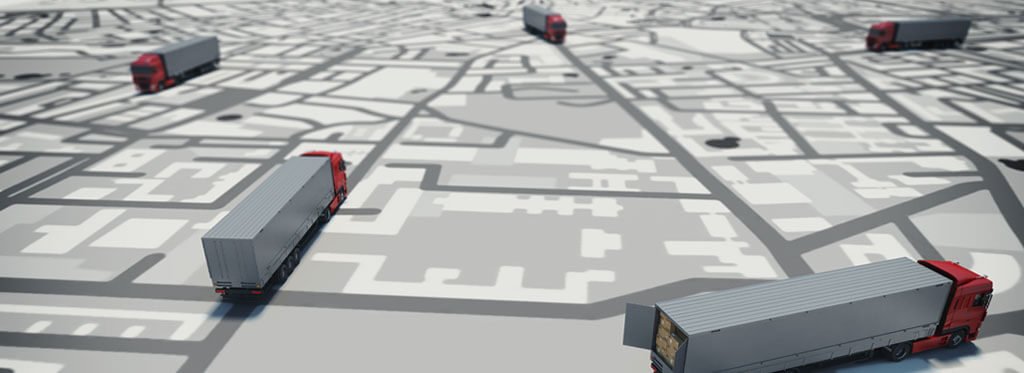
From fixed rules of thumb to learning algorithms
This is where AI makes the difference. Whereas traditional route optimization calculates a snapshot in time, an AI-driven approach learns from data and adapts to changing circumstances. This happens in roughly three ways.
First, the algorithms learn from historical data. Patterns in traffic volume, average unloading times per customer, and seasonal influences are factored in, making the schedule more realistic than a calculation on paper. In addition, adjustments are made in real time: based on current traffic, weather, and order information, the route planning is adjusted throughout the day. Finally, predictive planning (or predictive routing) makes it possible to anticipate what is likely to happen, rather than reacting only after things go wrong.
Technically speaking, modern solutions combine various techniques. Reinforcement learning is suitable for dynamically adjusting routes, supervised learning for predicting travel times, and hybrid approaches link proven operations research methods to machine learning. The result is not a replacement for traditional mathematics, but a smarter layer on top of it.
Data is the fuel of AI-driven route planning
An AI model is only as good as the data that feeds it. Four data sources in particular are crucial for optimizing delivery and transportation processes. Telematics data from vehicles provides location, speed, and fuel consumption. Historical trip and delivery data show how long tasks actually take in practice. Real-time traffic information makes it possible to adjust plans on the go. Customer-specific constraints, such as time windows and vehicle requirements, determine what constitutes a feasible schedule in the first place.
The common thread: without reliable, up-to-date, and easily accessible data, even the best algorithm will produce subpar planning. Data quality and availability directly determine how much an organization benefits from AI-driven route planning. This makes the integration with telematics and existing systems not a side issue, but a prerequisite.
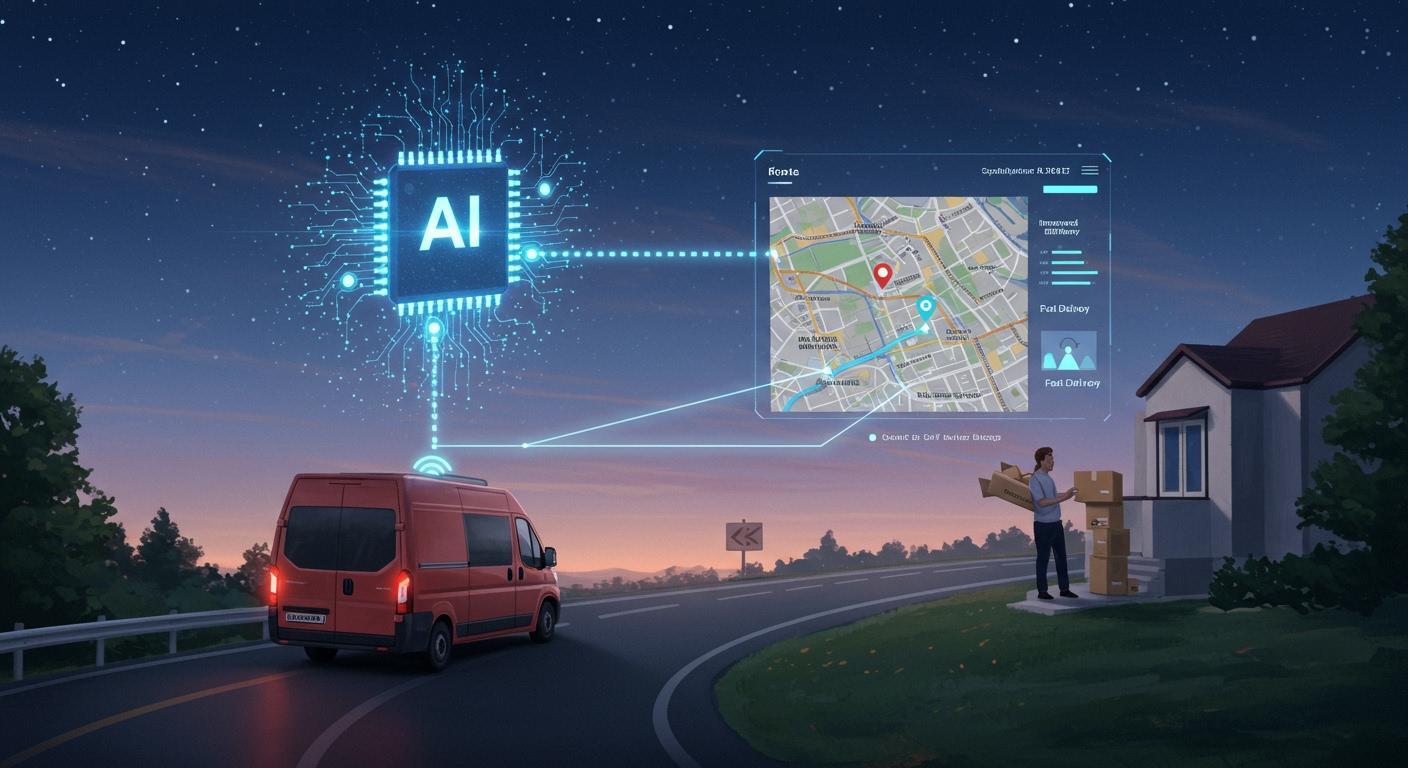
The real challenge lies in architecture and scalability
For an IT decision-maker, the complexity lies not so much in the algorithm itself, but in its integration into the existing IT and operational environment. A route must be calculated in seconds, not minutes, because a planner or driver cannot wait. This requires a careful balance between computation time and solution speed, as well as sufficient computing capacity that scales with the fleet and the number of orders.
In addition, the optimization must work seamlessly with the rest of the platform: planning, dispatching, and tracking. This often involves integration with an existing fleet management or TMS system, sometimes presenting the necessary legacy challenges. And a model isn’t finished once it goes live. Training, monitoring, and maintaining models in production is an ongoing process, because traffic and demand patterns are constantly shifting. Anyone who underestimates this aspect will end up with a fancy algorithm that, in practice, proves to be too slow or too inflexible.
Custom development or an off-the-shelf software package?
For logistics organizations, this is the key question. The market offers mature, off-the-shelf solutions for route optimization. PTV OptiFlow is a cloud platform capable of handling large order volumes and complex constraints. In early 2026, Aptean introduced Paragon Route 360, an AI-native solution with continuous, multi-day planning. For field service teams, including installers and technicians, the Dutch company OutSmart offers PlanSmart, an accessible scheduling tool. Such packages are attractive: they can be deployed quickly, are proven, and have relatively predictable costs. For organizations with a fairly predictable standard process, this is often the logical choice.
Yet in daily practice, many organizations run up against the limitations of off-the-shelf software. An off-the-shelf package forces you to follow the vendor’s logic, whereas your competitive edge may lie precisely in non-standard processes: unique constraints, a non-standard fleet composition, or deep integration with your own systems. In such cases, a custom solution offers advantages. You decide which variables to factor in, how the optimization integrates with your existing landscape, and how the model scales with your organization. Moreover, you don’t pay for features you’ll never use, and you aren’t dependent on a single vendor’s roadmap or licensing terms.
Of course, custom solutions also come with challenges. The initial investment is slightly higher, and development requires specialized expertise at the intersection of logistics, data, and AI. You’re also jointly responsible for the maintenance and ongoing development of the models, though you don’t have to handle this alone: an experienced development partner like NetRom can handle both the construction and the ongoing development of your custom software, ensuring your solution continues to grow alongside your organization. The decision between custom and off-the-shelf software is therefore primarily strategic: how unique and how dynamic is your logistics process?

What are the concrete benefits of AI-driven route planning?
The business value of AI-driven route planning is easy to quantify. More efficient routes mean fewer kilometers driven and, therefore, lower transportation costs. Reduced fuel consumption not only lowers costs but also cuts CO₂ emissions, a factor that carries increasing weight in reporting requirements and sustainability goals. Shorter and more reliable delivery times improve the customer experience, and smarter route planning lightens the workload for both the planner and the driver. For many organizations, the greatest benefit lies in agility: cost-efficient delivery routes that automatically adapt to the realities of the day provide a tangible competitive advantage.
Working together to build smarter route planning for your organization
Are you considering AI-driven route planning for your organization but unsure whether to choose a standard package or a custom software solution? We’d be happy to help you figure it out. NetRom Software has extensive experience developing custom solutions for the transportation and logistics sector. We combine our in-depth knowledge of software, data, and AI with a practical approach to what your process truly needs. Contact us for a free consultation, and together we’ll explore which approach best fits your delivery and transportation processes.

Why modernizing your legacy applications now will save you money later

CO₂ tracking for transportation companies: From mandatory reporting to lower operating costs