

After a careful selection process, an organization chooses off-the-shelf software that seems like a perfect fit. The implementation goes smoothly, the costs are predictable, and the vendor proactively contributes ideas. But after a few years, the situation gradually changes: prices rise, business-critical data is locked into a closed system, and switching to another vendor has become virtually impossible. The result is vendor lock-in, which stands in the way of an organization’s growth ambitions. In this article, you’ll learn how vendor lock-in arises, what the risks are, and what concrete steps you can take to prevent this situation.
What is vendor lock-in?
Vendor lock-in, also known as vendor dependency, is a situation in which an organization becomes so dependent on a specific software vendor that switching to an alternative product or service is difficult, very costly, or technically nearly impossible.
In practice, it’s often assumed that vendor lock-in occurs exclusively with off-the-shelf software. That’s a misconception: you can also get stuck with custom software- namely, if you become too dependent on the development partner who wrote the code.
An organization that opts for off-the-shelf software often sees advantages at first: low upfront costs, the convenience of a single point of contact, and seamless integration between services from the same vendor. But as soon as your organization becomes more deeply intertwined with the platform, the disadvantages become apparent.
That said, vendor lock-in doesn’t always have to be a problem. As long as prices remain in line with the market, the service is good, and the vendor continues to innovate, the dependency can be manageable and acceptable. Off-the-shelf software has a large user base that generates a stable revenue stream, which in turn creates opportunities for innovation. But experience shows that the balance of power often shifts to the vendor’s advantage as dependence grows.
How does vendor lock-in occur?
Vendor lock-in almost always develops gradually and often goes unnoticed. With off-the-shelf software, you opt for a ready-made solution that you share with thousands of other users. The vendor determines the architecture, data formats, integration options, and roadmap. An organization adapts to the software, rather than the other way around.
With custom software, the risks are different, but no less real. Dependency arises here when the development team uses proprietary frameworks or closed libraries, does not transfer the source code, or provides insufficient documentation. The result is the same: switching to another provider becomes disproportionately expensive and complex.
In an on-premises environment, your data and systems reside on your own servers, giving you full control. With SaaS solutions, that control is more limited: business data resides outside your own IT environment and is subject to the provider’s terms and conditions. This dependency grows through various mechanisms:
- Proprietary software and closed systems: the provider uses its own data formats, protocols, or technologies that are incompatible with other providers.
- Limited export options: It is difficult or impossible to export your own data to another platform.
- High switching costs: Migration requires so much time, money, and effort that your organization would rather stay with the current provider.
- Lack of standardization: Without open standards, you are tied to the vendor’s specific implementation.
API dependency: how vendor lock-in creeps up on you
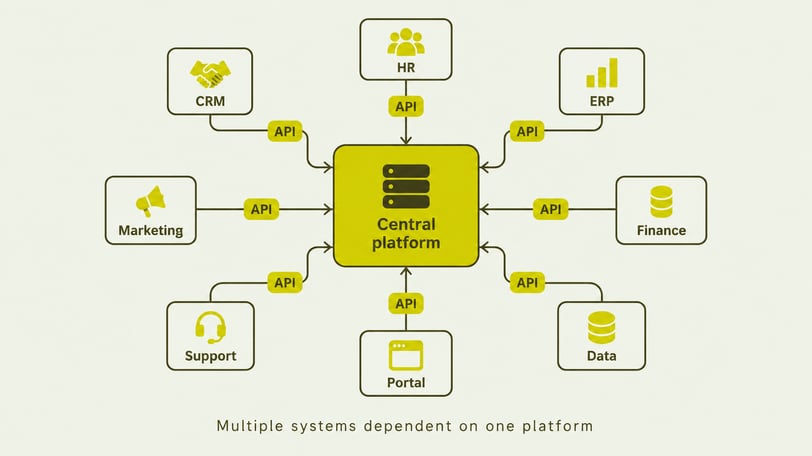
A common but underestimated factor in vendor lock-in is API dependency. When you use off-the-shelf software, you build connections with other systems via that vendor’s APIs (Application Programming Interfaces). These APIs are proprietary: they operate according to the vendor’s specifications, not according to an open standard.
Every system you integrate via a proprietary API increases your dependence. Your development team writes integration code that is specific to that one platform. If you want to switch, all that integration code must be rewritten. The more integrations, the higher the migration costs, and the greater the barrier to actually switching. In practice, API dependency thus becomes one of the strongest mechanisms driving vendor lock-in.
The Relationship Between Technical Debt and Vendor Lock-in
Technical debt is the sum of all workarounds, temporary solutions, and suboptimal technical choices that an organization makes over time. In the short term, these deliver speed, but in the long term, they lead to extra costs, risks, and reduced agility. With off-the-shelf software, technical debt arises almost inevitably: you build scripts and customizations around the platform’s limitations, you store data in the vendor’s format, and you develop processes tailored to that specific system.
This technical debt reinforces vendor lock-in- and vice versa. Every workaround you build to compensate for a missing feature is both a technical debt and an additional tie to the vendor. The more workarounds there are, the greater the migration risk and the higher the switching costs. As a result, organizations stay with a vendor longer than they should, even when that vendor no longer meets their needs- a classic vicious cycle that’s difficult to break.
Vendor lock-in in hardware: the CPU example
Vendor lock-in isn’t limited to software. You can also get locked in at the hardware level, for example, through dependence on a specific processor architecture (CPU). If your organization chooses a software platform that runs exclusively on hardware from a single chip manufacturer, you’re locked in there as well. Switching to a different architecture then means not only new hardware, but often also modifications to your entire software stack. This principle also applies in the world of cloud providers: anyone who builds their infrastructure entirely within a single provider’s cloud environment - whether using standard software or a custom solution- creates a dependency that extends beyond just the application layer.
Open Standards vs. Proprietary Solutions
The difference between open standards and proprietary solutions is crucial in preventing vendor lock-in. Open standards are publicly available specifications supported by various vendors. Examples include REST APIs, JSON, XML, OAuth, and SQL. Software built on open standards makes it easier to switch vendors without major disruptions.
Proprietary solutions, on the other hand, rely on closed formats, proprietary protocols, and vendor-specific technologies. The data and functionality are inextricably linked to the vendor’s platform. If you want to migrate, you must not only replace the software but also convert the data and rebuild all integrations.
Choosing open standards is therefore one of the most effective ways to prevent vendor lock-in. With custom software, you have the freedom to opt for open technologies and standards from the start, ensuring you always retain control over your own systems and data.
How the EU Data Act addresses vendor lock-in
The EU Data Act has been in effect since September 12, 2025. This European regulation tackles vendor lock-in on three fronts.
First, cloud service providers (IaaS, PaaS, and SaaS) must allow customers to switch to another provider at any time, with a notice period of no more than two months. As of January 12, 2027, switching fees for cloud services must be completely eliminated.
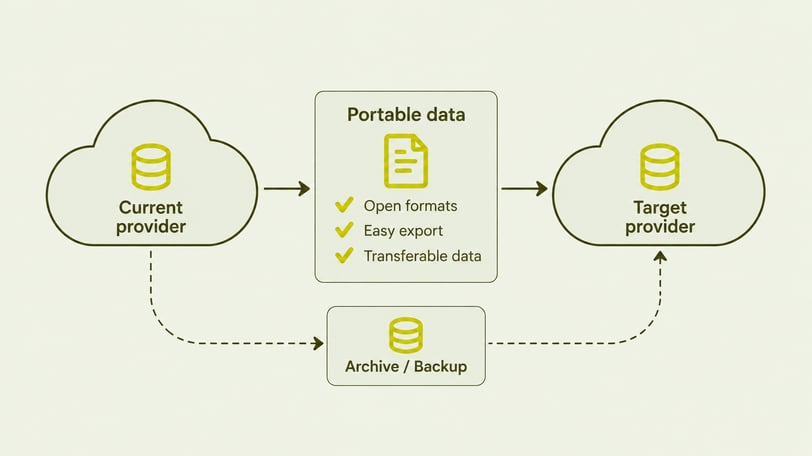
Second, the law grants customers the right to data portability: providers are required to allow data to be exported in structured, machine-readable formats at no additional cost. This applies not only to the files themselves but also to metadata and associated context.
Third, the EU Data Act imposes technical, contractual, and organizational obligations to ensure portability and interoperability between services. Providers must explicitly include termination options in their contracts, including a clear migration procedure. The regulation also applies to non-European providers serving EU customers.
The EU Data Act offers organizations strong legal protection against vendor lock-in, but legislation alone is not enough: they must also continue to think critically about an independent IT strategy.
7 tips to prevent vendor lock-in
Prevention is always better than cure. The tips below will help you increase your chances of avoiding vendor lock-in.
1. Choose open standards and common programming languages
Have your business-critical software developed based on open standards supported by multiple vendors. Choose widely used programming languages for which a large pool of developers is available. This makes a potential switch to another vendor considerably easier.
2. Clarify the intellectual property rights to your source code
Establish clear agreements regarding ownership of the software. Is the source code truly yours, or are you merely paying for the right to use it? Ensure that your development partner does not use proprietary, closed-source libraries or frameworks, but instead opts for open-source and freely usable licenses. This prevents you from becoming dependent on technology controlled exclusively by that one party.
3. Document everything related to software development
Good documentation makes a potential transition much easier. Another software developer must be able to understand exactly how the software is structured, what architectural choices were made, and how the various components work together. The software should not be unnecessarily complicated or illogically structured, because a successor service provider must be able to work with it.
4. Establish clear contractual agreements
Set out clear terms in the contract regarding development costs, support costs, and annual updates. Prevent unexpected price increases by explicitly linking maximum price increases to an objective price index, such as the one published by Statistics Netherlands (CBS). Also include a “data reversibility” clause: this gives you the right to retrieve your data from the supplier at any time.

5. Develop an exit strategy
Work with your IT vendor to draw up an exit plan in a spirit of cooperation. Agree now on migration costs, the data migration procedure, and the support the vendor will provide during any transition. For custom software, ownership of the source code is the starting point: ensure that the contract explicitly states that the code belongs to you. Also consider an escrow arrangement in which the source code is held in trust by an independent party. Should the development partner go bankrupt or fail to meet its obligations, you will still retain full access. With off-the-shelf software, you never own the source code, and that fact makes a well-thought-out exit plan even more important.
6. Conduct periodic audits of your software vendor
A “right to audit” gives you the right to conduct interim audits of your supplier. Don’t just schedule these audits when a relationship is deteriorating- make them a structural part of your supplier management. This way, you can continuously monitor the quality, security, and compliance of your software environment.
7. Choose a reliable development partner
The most important factor is choosing a partner who takes open standards, documentation, and portability seriously from the very beginning. Transparency and a focus on your interests are crucial. A reliable development partner builds solutions with a clear, logical architecture and provides thorough documentation. This ensures that any successor can seamlessly take over.
Avoiding vendor lock-in with custom software?
At NetRom Software, we believe it’s important for organizations to maintain control over their own software, code, and data. With custom software development, solutions can be built from the start using open standards, a transferable architecture, and clear documentation. This reduces your dependence on a single vendor and allows you to maintain control over your IT landscape.
Custom software typically requires a larger initial investment than off-the-shelf software, but it gives you more control over technology choices, integrations, and further development. By establishing agreements in advance regarding source code, documentation, and portability, the software remains manageable in the long term.
We also take this independence into account when implementing AI. Our teams work with modular architectures and open standards, so you don’t become unnecessarily dependent on a single AI model or provider. You can read more about this under AI and Machine Learning.
Would you like to know how to limit vendor lock-in within your software landscape? Contact us for a no-obligation consultation about the possibilities of custom software.