

Every few years, IT decision-makers face the same choice: do you opt for an off-the-shelf software package, or do you invest in a custom solution tailored specifically to your organization? At first glance, off-the-shelf software seems like the most obvious choice: a proven solution, quick implementation, and lower initial costs. But that choice can have consequences that organizations often don’t fully realize until later: workarounds that gradually pile up, processes that have to adapt to the software, significant vendor lock-in, and mounting technical debt that slows down innovation.
The choice between off-the-shelf and custom software depends on the specific situation. Off-the-shelf software is a logical choice for generic processes found in virtually every organization, such as accounting, email, or project management. But as soon as software plays a crucial role in distinctive business processes, involves complex integrations, or requires workflows that cannot be supported by a standard solution, it makes sense to consider custom software.
Off-the-shelf software versus custom software development
First of all, what is the difference between off-the-shelf and custom software? Off-the-shelf software, also known as commercial off-the-shelf (COTS) software, is developed for a broad group of users with common processes in mind. Custom software is designed and built specifically for a single organization, based on its own requirements, by an internal team and often with the support of a specialized development partner.
Advantages of custom software
Let’s take a closer look at the advantages of custom software. We’ll cover ten reasons why custom software not only optimizes current operations but also paves the way for future growth. “We strongly believe in custom software,” says our CEO, Jaap Merkus. “Off-the-shelf software is developed for the lowest common denominator. That means you end up with features you don’t need while missing the ones you actually do need.”
1. Fully tailored to your unique business processes
Every organization operates in its own way. Yet off-the-shelf software packages force companies to adapt their processes to the software, rather than the other way around. The result: inefficient workflows, manual steps, and cumbersome workarounds just to make the system work. We regularly see “old” software continue to run in certain areas for too long simply because shutting it down is too much of a hassle. With outdated systems, legacy modernization can also play an important role.
A solution that’s 80% a good fit may seem attractive on paper, but it’s precisely that remaining 20% that can be crucial for business-critical processes. Off-the-shelf software is designed for a broad user base and is therefore never perfect for anyone: it’s packed with features you don’t need while lacking the ones that make a real difference for your organization.
Custom software is built around how your organization actually operates. Every screen, every workflow, and every automation feature is designed to support your specific processes. The software adapts to the organization, not the other way around. This directly translates into higher productivity, fewer errors, and employees who can focus on work that matters rather than on working around software limitations.
2. Flexible and scalable as your organization grows
Scalability starts with the question: Will this software still fit the organization you want to be in three to five years? A fast-growing company has fundamentally different software requirements than a stable organization. Growth brings change: new markets, additional product lines, more users, and more complex processes.
Many organizations logically start with a standard software package: employees can get up and running quickly, and the initial investment is relatively low. But as the organization grows, companies begin to run into limitations. With standard software, licensing costs often rise significantly, while functionality doesn’t always keep pace. You’re tied to the vendor’s roadmap and dependent on the priority that vendor gives to your needs. At that point, organizations may begin to consider custom software, which can lead to higher migration costs than if they had made that choice earlier.
With custom software, you set the pace and direction yourself. New modules, integrations, or features can be added when the organization needs them. You scale in the direction your business requires and can capitalize on both current and future market opportunities.

3. Seamless integration with existing systems and technologies
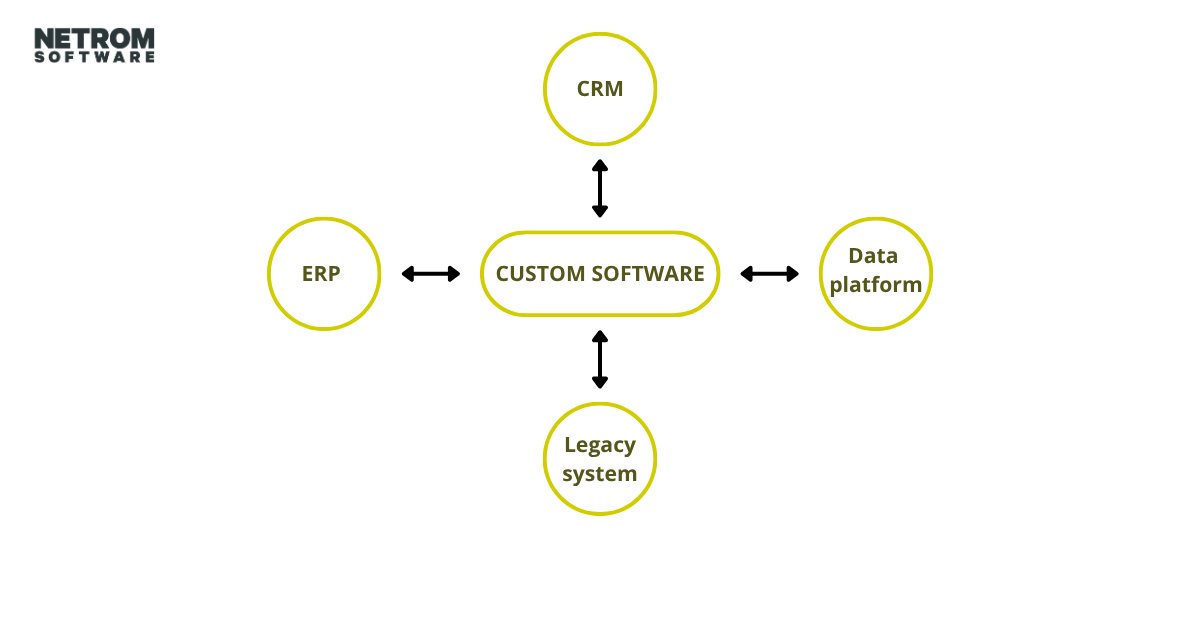
New software never stands alone within an organization. The average organization uses dozens of applications to support its business operations. Integration with existing systems such as ERP, CRM, data platforms, or legacy applications, is one of the most underestimated factors when choosing between off-the-shelf and custom software.
Off-the-shelf software typically offers APIs and connectors, but in practice, these can come with serious limitations. Think of rate limits that determine how many requests you can make within a certain period, data limits that restrict how much information you can retrieve at once, functionality limits that determine what you can do through the API, subscription-based restrictions that require additional payment, and throttling (the deliberate limitation of requests, operations, or processing speed during a specific period). In environments where multiple systems need to communicate with each other, these restrictions can seriously disrupt business operations. Data silos emerge, duplicate data entry becomes common, and the IT environment becomes increasingly fragmented.
Custom software is designed around your existing technology stack, with clear integration principles and architectural choices from the outset. The result is an integration architecture tailored to your environment, including the ability to connect to legacy systems through dedicated APIs. This significantly reduces the risk of data silos. Whether it’s a connection to your ERP, CRM, or data warehouse, the integration is designed to be stable and maintainable, without unnecessary workarounds or middleware.
4. Full control over functionalities and the user interface
With off-the-shelf software, you’re bound by the vendor’s choices; including dozens of features you don’t need while missing the few you actually need, either now or in the future. Updates are rolled out on the vendor’s schedule and may include changes that disrupt your workflows. You often pay for a package that includes functionality you barely use. The result can be an unnecessarily complex interface that hinders rather than improves your team’s productivity.
Custom software gives you full control. You decide which features to build, what the interface looks like, and when updates are released. There’s no unnecessary complexity, no unwanted changes, and fewer surprises after an update. You build what you need, in the way your organization needs it.
5. Competitive advantage over Rivals
If you and your competitors use the same off-the-shelf software, you are, by definition, working with many of the same capabilities and limitations. This makes it harder to differentiate yourself through software. If you rely on the same standard solution as your competitors, it becomes more difficult to excel at the process level and build a competitive advantage.
Custom software is tailored specifically to your organization. It enables you to digitize processes in ways that competitors cannot easily replicate. Think of a superior customer experience, faster turnaround times, or data-driven decision-making tailored specifically to your market. While off-the-shelf software often puts organizations on a similar footing, custom software gives you the opportunity to differentiate.
A simple rule of thumb: use off-the-shelf software for generic business processes that every organization deals with, such as financial administration, HR, and email management. Use custom software for the processes that help your organization stand out and create a competitive advantage.

6. Ownership of the source code
With off-the-shelf software, you are a licensee, not the owner. You have no access to the source code, no control over the architecture, and no guarantee of continuity if the vendor is acquired, discontinues the product, or significantly raises its prices. It creates a dependency in which the vendor largely determines the terms.
With custom software, you can make agreements about ownership of the source code. That ownership is a strategic advantage that is often underestimated. It provides greater transparency, greater independence, and the freedom to choose who maintains and further develops the software. You can switch development partners, build an in-house team, or have multiple parties work on the application in parallel. You determine the pace, strategic direction, and priorities.
7. Lower total cost of ownership in the long term
The purchase price of a software package is only a fraction of its actual cost. To make a fair comparison, it makes sense to look at the total cost of ownership (TCO) over a period of at least five and preferably ten years.
Off-the-shelf software may seem cheaper at first. The initial costs are relatively low, and you can get up and running quickly. But costs can rise significantly over time. With SaaS solutions, you typically pay recurring subscription fees that increase as you add users or consume more resources. Add annual price increases, implementation costs, training, premium support, add-ons for missing functionality, and consulting fees for configuration and workarounds, and the initial cost advantage can disappear faster than expected.
Custom software requires a higher initial investment. The development process involves several phases: business process analysis, design, development, testing, and fine-tuning after deployment. However, depending on the solution and agreements in place, you may avoid recurring per-user license fees for the custom application itself. The software may also be owned by your organization, depending on the contractual agreements. As the application matures through ongoing development, maintenance can become more predictable and efficient. In some cases, the investment can pay for itself within several years, depending on complexity, usage, and the efficiency gains achieved through optimized business processes and reduced manual work.
When weighing the pros and cons of off-the-shelf versus custom software, it’s important to perform a realistic TCO calculation that includes both direct and indirect costs: from licenses and maintenance to process adjustments and missed efficiency gains.
| Standard software | Custom software |
| License / subscription fees | Analysis & design |
| Per-user / resource costs | Development & testing |
| Annual price increases | Fine-tuning after launch |
| Implementation & training | Maintenance (declining over time) |
| Add-ons & premium support | Further development |
| Consultancy, configuration & workarounds | |
| Costs keep rising with more users, more resources and every year | After delivery: no recurring per-user license fees |
8. Improved security and privacy
Off-the-shelf software can be an attractive target for attackers precisely because it is widely used. A vulnerability discovered in a widely adopted software package can potentially affect many organizations at once. In addition, you typically have limited control over how the underlying security architecture is designed and how your data is stored and processed. While major vendors often hold extensive certifications such as ISO 27001, NEN 7510, or SOC 2, certifications alone do not give you control over the security architecture.
With custom software, security measures can be designed around your organization’s specific risk profile. You have more control over data storage, encryption, access management, and architectural security decisions. You can also determine where business-critical data is stored—an increasingly important consideration in today’s geopolitical and regulatory landscape.
In sectors with strict compliance requirements, such as financial services, healthcare, or government, this level of control can be particularly important. Determine in advance which compliance requirements are non-negotiable and factor them into your decision.
9. Greater control and less dependence on external vendors
Vendor lock-in is one of the most underestimated risks of off-the-shelf software. The vendor determines which updates and improvements are released, and these decisions are made for the market as a whole rather than for your organization’s specific needs. As an individual customer, you typically have limited influence over that roadmap. What happens if the vendor is acquired, discontinues support, or significantly increases its prices? Migrating to an alternative can be so costly and complex that organizations remain tied to a solution that no longer meets their needs.
With custom software, you have greater control over the direction of the software. You’re less dependent on a single vendor’s roadmap, pricing policy, or business continuity. Depending on the agreements in place, you can retain control over the source code, data, and ongoing development and maintenance. This means you are not necessarily tied to a single development partner.
Both types of software carry a risk of lock-in, but the nature of that risk differs. With off-the-shelf software, the dependency primarily lies with the product and its vendor. With custom software, the risk often lies in the knowledge held by the development team. That risk can be actively managed by working with a professional development partner that takes a structured approach to documentation, knowledge retention, and knowledge transfer.

10. Higher user adoption through intuitive workflows
Software only delivers value when employees actually use it. Off-the-shelf software packages are designed for a broad user base, resulting in generic interfaces with features your team may not need. The result: lower adoption rates, shadow IT (such as standalone spreadsheets and unauthorized tools) and employees falling back on manual workarounds.
Custom software is built around your users. The interface shows them exactly what they need, workflows align with the way they work every day, and the learning curve can be significantly reduced. By involving end users early in the development process, you build software that is not only functionally sound but also intuitive to use.
This increases the likelihood of successful adoption: less frustration, less need for training, and a faster return on investment. After all, software that isn’t used doesn’t deliver value, no matter how much you paid for it.
Ready for custom software that truly fits your organization?
Is off-the-shelf software no longer a good fit for your organization and business objectives? And do you want to take full advantage of what custom software can offer?
For more than 25 years, NetRom Software has been developing custom software for organizations that want to use technology strategically. With more than 500 university-educated IT specialists, we combine technical expertise with domain knowledge to bring custom software solutions to life.
We work with both blended and dedicated teams across sectors such as finance, manufacturing, healthcare, and transportation. Our experienced development teams collaborate closely with clients throughout the entire process, from architecture and development to delivery and ongoing evolution. We believe in building long-term partnerships that support both your current needs and future ambitions.

Transparent communication in software development: improving collaboration
.png)
Technical debt in off-the-shelf software: the hidden obstacle to growth and innovation