

The biggest costs in software development don’t always stem from poor code. Often, they result from earlier decisions: a problem that wasn’t defined clearly enough, untested assumptions, overly optimistic scheduling, or maintenance that the team kept putting off. The consequences of these choices usually only become apparent later on. A project runs over schedule, modifications become increasingly expensive, vulnerabilities arise, or an application ends up holding the organization back instead of helping it move forward.
For IT decision-makers, therefore, it’s about more than just technical quality. Choices in software development have a direct impact on costs, continuity, the speed of change, and business risk.
Development teams now work with AI assistants that generate code, suggest tests, and write documentation.Even in an AI-augmented SDLC, incorrect assumptions can quickly have repercussions if coordination and oversight are lacking.
In this article, we discuss six common and costly mistakes. They arise in three phases of the software life cycle: when understanding the problem, during implementation, and in maintenance and further development.

Refining the problem and assumptions
Before a team writes even a single line of code, a significant portion of its future success is already determined. The first two mistakes, therefore, are not about technology but about understanding: are we solving the right problem, and are all stakeholders working from the same set of assumptions?
1. Building before the problem is clear
Teams often make one of the most costly mistakes early in a software project: starting to build before it’s clear what problem the software is actually supposed to solve.
The team translates a request for a new feature directly into functionality, without sufficiently investigating the underlying need. The result may be technically excellent yet deliver little value. That’s what makes this mistake so costly. Often, it’s only after a significant investment that it becomes clear the team has built the wrong solution.
Example: A logistics service provider wants a dashboard with real-time insight into fleet data. The team builds a comprehensive reporting system. After delivery, it turns out that planners mainly want to be able to quickly see which vehicles require attention. A simple list of exceptions would have delivered more value and cost less.
Here’s how to reduce this risk:
- Make a conscious effort to take the time to understand the question behind the question before development begins. Use requirements engineering to clearly define the business problem, end-user needs, and the desired outcome before you start building.
- Involve end users early on and verify whether their actual needs align with the original wish list.
- Make it explicit which business problem you want to solve and what outcome the investment should deliver.
- Validate the problem and the goal before investing substantially in a solution.
For an IT decision-maker, the key question is simple: what demonstrable business problem are we solving with this?
2. Assumptions that no one checks
Once development is underway, a second risk arises: assumptions that no one explicitly states or verifies. A developer interprets a requirement in a certain way. An architectural choice remains within the technical team, or the team takes a dependency for granted. It isn’t until much later that it becomes clear that other stakeholders were working from different assumptions.
AI assistants increase this risk. If a requirement is incomplete, a model fills in the gaps with plausible assumptions: an assumed data model, an assumed error-handling strategy, an assumed sequence. These assumptions aren’t written down anywhere, and no one has consciously made them. They exist only in the generated code, where they only become apparent when integration goes wrong.
Many problems that seem technical in hindsight are therefore fundamentally related to communication and decision-making.
Example: A team develops an integration based on an assumed API structure. During integration testing, it turns out that the source system uses different statuses and exceptions. The necessary adjustments then take more time than the original development.
Here’s how to keep assumptions visible and verifiable:
- Make key assumptions explicit.
- Document relevant decisions and assumptions, for example in decision logs.
- Ensure that business, product, and technology teams regularly review the same assumptions.
- Let developers contribute ideas about the problem and the solution instead of merely fulfilling tickets.
- Organize short, frequent feedback sessions so that incorrect assumptions don’t carry over into multiple sprints.
The key management question here is: Which unproven assumptions are currently driving our planning, architecture, or business case?
Executing software projects in a manageable way
Once it’s clear what you’re building, the risk shifts to execution. At that point, the focus is primarily on predictability, quality, and the ability to identify uncertainties in a timely manner.
3. Estimates that come to be treated as firm commitments
Software development always involves uncertainty. Yet many organizations are quick to treat early estimates as if they were firm commitments. This is risky, because it is precisely the work that isn’t yet visible at the outset that can have a major impact on the schedule. Think of integrations, exceptions, dependencies on external systems, legacy code, and changes in requirements.
Furthermore, when a rough estimate turns into a firm deadline, a second risk arises: quality comes under pressure because the team tries to meet the original expectation at all costs.
Also, distinguish between effort and lead time. For example, a development task might involve twenty workdays of work, but due to dependencies, wait times, and limited availability, it could still take eight calendar weeks.
AI amplifies this pressure. Because code generation is faster, expectations quickly arise that the entire project will be completed correspondingly faster. But writing code was rarely the bottleneck. Effective planning therefore also requires a development process in which teams discuss uncertainties in a timely manner and regularly adjust their approach.
Example: A team estimates that it can build an integration in three weeks. During development, it turns out that the external system has its own release cycle and that the team must handle additional exceptions. The actual turnaround time extends to over two months, while the team already considers the original estimate to be the deadline internally.
Here’s how to increase predictability:
- Whenever possible, work with ranges rather than a single exact number.
- Make uncertainties and dependencies explicit.
- Update estimates when new information becomes available.
- Distinguish between an initial estimate, a schedule, and an actual commitment.
- Focus not only on a deadline, but also on scope, risk, and delivered value.
The key management question here is: Do we treat our initial estimates as hypotheses or as firm commitments?
4. Quality and security as the final step
Under time pressure, testing, security, and quality measures easily get pushed to the end of a project. In the short term, this seems to save time. In the long term, however, it actually increases the risk of disruptions, remediation costs, and security incidents. Problems that only surface in production are typically more complex and more expensive to fix than when a team identifies them early in the development process.
The same applies to security. Adding security only after development is complete often leads to costly modifications and fails to adequately address structural vulnerabilities. Consider, for example, authorizations, logging, data validation, dependencies on external libraries, and the secure processing of personal data.
Moreover, with AI assistance, the focus shifts from writing to reviewing. A team can produce more code in less time, while the capacity for code reviews does not automatically scale accordingly. Generated code can call upon outdated libraries, adopt insecure patterns, or introduce dependencies that no one consciously chose. That is why human review and automated quality checks are becoming increasingly important.
Example: Because the team postpones testing until the end of a project, a billing error isn’t discovered until after the system goes live. Customers receive incorrect amounts, and fixing the error, correcting the data, and mitigating the impact on customers costs significantly more than early automated testing would have.
Here’s how to build quality and security in from the start:
- Integrate software testing and QA into the development process from the start, using automated tests, static code analysis, dependency scans, and security checks in the CI/CD pipeline.
- Make quality part of the Definition of Done rather than a separate final phase.
- Apply “security by design” to architectural and design choices.
- Give teams the freedom to address vulnerabilities and structural quality issues immediately.
- Make risks related to quality and security transparent to both technical teams and management.
For executive leadership and IT management, this is not a technical detail: what operational risks and recovery costs are we accepting by treating quality and security as an afterthought?

Sustainable software maintenance
Software isn’t finished once it goes live. In fact, that’s when the longest phase of its lifecycle begins. The last two pitfalls therefore relate to technical debt, maintenance, and continuity. It is precisely this phase that determines whether software will continue to deliver value for years to come or increasingly become a liability for the organization.
5. Technical debt that no one pays off
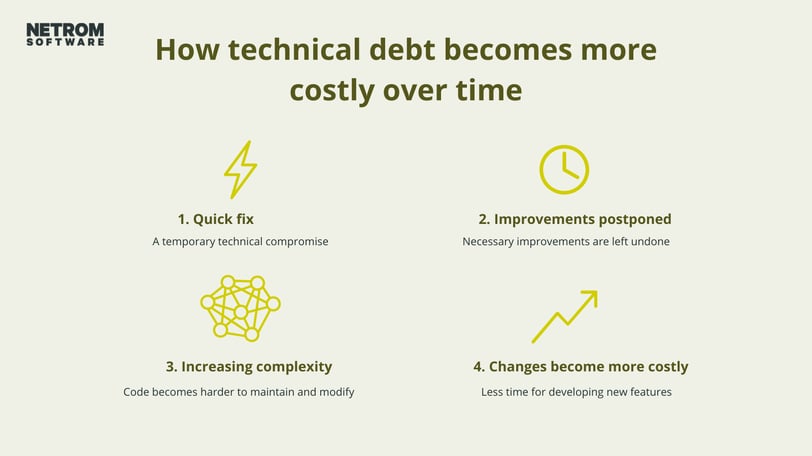
Technical debt is virtually unavoidable. Sometimes it’s even a conscious and sensible choice to deliver faster and implement a technical improvement later.
The problem arises when that temporary choice becomes permanent. If technical debt remains unresolved over the long term, complexity increases. New functionality takes more and more time to implement, changes unexpectedly affect other components, and teams become more cautious because every modification carries risks. Technical debt is therefore not just a technical problem. It directly impacts development speed, costs, and the organization’s agility.
AI also accelerates the accumulation of technical debt. Code that is written quickly and that no one on the team fully understands is, by definition, a form of debt. The first major change reveals just how little understanding there is behind it.
Example: An application runs for years without any systematic maintenance of its outdated code. Eventually, a relatively minor feature change affects so many components that a modification that would normally take a day ends up taking an entire sprint.
Here’s how to keep technical debt manageable:
- Make technical debt visible and open to discussion.
- Prioritize improvements based on their impact on risk, costs, and development speed.
- Systematically set aside capacity for necessary technical improvements.
- Make clear what consequences delays will have for future projects.
- Where possible, link technical improvements to specific business goals, such as faster releases, greater stability, or lower management costs.
The relevant management question is: How much of our capacity for change is now being consumed by past decisions?
6. Underestimating maintenance and continuity
A final common mistake is building software as if delivery were the end point. In reality, software incurs costs throughout its lifecycle for management, security updates, monitoring, infrastructure, incidents, and ongoing development. Managed services can support part of this operational management. Knowledge retention is also important. When crucial information is held by only a few people, staff turnover can have immediate consequences for continuity.
As a result, a modern application can gradually turn into a legacy system that is difficult to manage, even if the technology was excellent at the time of delivery.
Example: An application functions well technically, but only one employee knows exactly how deployments, backups, and critical integrations work. When that knowledge is lost, even routine changes and incidents pose an operational risk.
Here’s how to make software ready for the long term:
- From the start, take into account the entire lifecycle and the associated costs.
- Ensure that critical knowledge is retained within a team rather than by individual employees.
- Set up monitoring and logging so that problems are detected early.
- Document components that won’t be easy to reconstruct later.
- Incorporate manageability, maintainability, and continuity into architectural decisions.
- Regularly assess whether the software still meets changing business and security requirements.
The relevant management question is: Do we plan for the entire lifecycle, or does our focus end at delivery?
Don’t let temporary choices turn into permanent limitations
At first glance, the six mistakes seem different, but they share the same underlying cause: choices that are attractive in the short term but whose costs only become apparent later.
Getting started quickly without fully understanding the problem. Not verifying an assumption because it takes time. Sticking to an optimistic schedule. Postponing testing. Ignoringtechnical debt. Waiting to organize maintenance until the software is already up and running.
None of these decisions has to be wrong in and of itself. The risk arises when their consequences are not sufficiently visible and temporary concessions turn into established patterns.
AI does little to change that pattern. It mainly shortens the time between a temporary choice and the moment when it becomes a permanent limitation. Teams that already had their assumptions, quality requirements, and maintenance agreements clearly defined benefit from the increased speed. Teams that didn’t will only see their problems pile up faster.
That is why successful software development is not just a technological issue. It also requires sound risk management, clear accountability, and a way of working in which business and technology make decisions together.
Prevent errors with the right way of working
Technology alone cannot prevent these errors. The way teams organize themselves and collaborate also has a major impact on the outcome.
Stable development teams gradually acquire in-depth knowledge of both the software and the business context. As a result, they identify dependencies and risks earlier and make better substantive decisions.
At NetRom Software, experienced and motivated developerswork together long-term in permanent teams. As a result, they build not only knowledge of the software but also of the organization and the processes in which that software plays a role. Driven by a culture of ownership and close collaboration, they actively contribute ideas and build custom software with an eye toward the entire lifecycle.
Our development teams also use AI as a tool, but we do not rely on it exclusively. Code we write for your organization must remain understandable to our own developers. That is why we review all code we deliver,document design choices anddependencies, and ensure that responsibility for the content remains with people. AI speeds up the work where possible, but it does not determine what ends upin your custom application.
It is precisely for this reason that the risks discussed in this article remain manageable in our projects. We test assumptions rather than tacitly accepting them; quality and security are built into the development process itself; and knowledge about the application remains within the team rather than with individual team members. This results in software that works today and remains affordable and adaptable in the long term.
Would you like to explore how a stable development team can help limit risks,technical debt, and unpredictability in your software project? Contact us for a no-obligation consultation. We’d be happy to discuss where the greatest opportunities lie in your software development.

Jaap Merkus on the future of software development: “AI makes good developers even better”

Why Developer Experience (DevEx) is critical to successful software development