

A fleet management platform runs 24/7, continuously processes real-time data from hundreds or thousands of vehicles, and must be able to scale with the fleet. This places high demands on design, development, and management. With a DevOps approach, you don’t treat these components as separate phases, but as a single, continuous process that combines speed, security, and reliability. In this article, you’ll learn what concrete benefits this brings to your platform and your operations.
Logistics never stands still. For many organizations in transportation and logistics, the transportation and logistics is business-critical. It shows vehicle locations in real time, supports route planning, monitors driving and rest times, and exchanges data with other systems. If the platform goes down or responds too slowly, planners, drivers, and customers quickly lose track of operations.
At the same time, the environment is constantly changing. Fleets are growing, data flows are increasing, laws and regulations are evolving, and customers expect new features faster. A traditional approach, in which development and operations are strictly separated, falls short in this context. DevOps brings together multidisciplinary teams, automated processes, and continuous feedback. This creates not only a platform that works today but one that can continue to operate reliably as requirements change.
A fleet management platform has unique requirements
Before we look at the benefits, let’s outline the key characteristics and design considerations:
- Continuous data processing. Telematics and sensor data flow in continuously, often in real time and in large volumes.
- High availability. Planners, drivers, and customers rely on up-to-date information, even during maintenance and software releases.
- Sensitive data. Location and driver data require careful handling, appropriate security, and clear retention periods.
- Numerous integrations. These include telematics hardware, map and routing services, tachograph systems, fuel cards, and ERP and planning systems.
- Design for manageability. Decisions regarding architecture, data models, security, recovery objectives, and service levels determine how easy the platform will be to test, scale, and maintain in the future.
This combination calls for an approach that balances speed with stability. DevOps makes manageability, security, and measurability integral parts of the design, so they aren’t addressed only after the initial release. It is precisely when architecture, security, and operational management are considered in isolation from one another that risks arise which later limit the platform’s scalability and continuity. Read more about what mistakes to avoid when developing a fleet management platform
Continuous availability and rapid releases
In the transportation industry, you can’t afford to shut down the platform regularly for maintenance. With CI/CD pipelines (continuous integration and continuous delivery), you can roll out new features and updates frequently and in a controlled manner, with minimal disruption to operations. Changes are automatically tested, built, and deployed. This shortens turnaround time, provides faster feedback, and reduces the risk of manual errors.
Release strategies such as blue-green deployments and canary releases further reduce the risk. With blue-green deployments, the old and new environments run side by side, and you switch over after validation. With a canary release, a small portion of users or vehicles receives the new version first. Only when monitoring shows that the agreed-upon thresholds are not exceeded do you scale up. This allows you, for example, to roll out an additional report, support for a new type of sensor, or a change in routing logic in a controlled manner.

Scaling with your transportation fleet
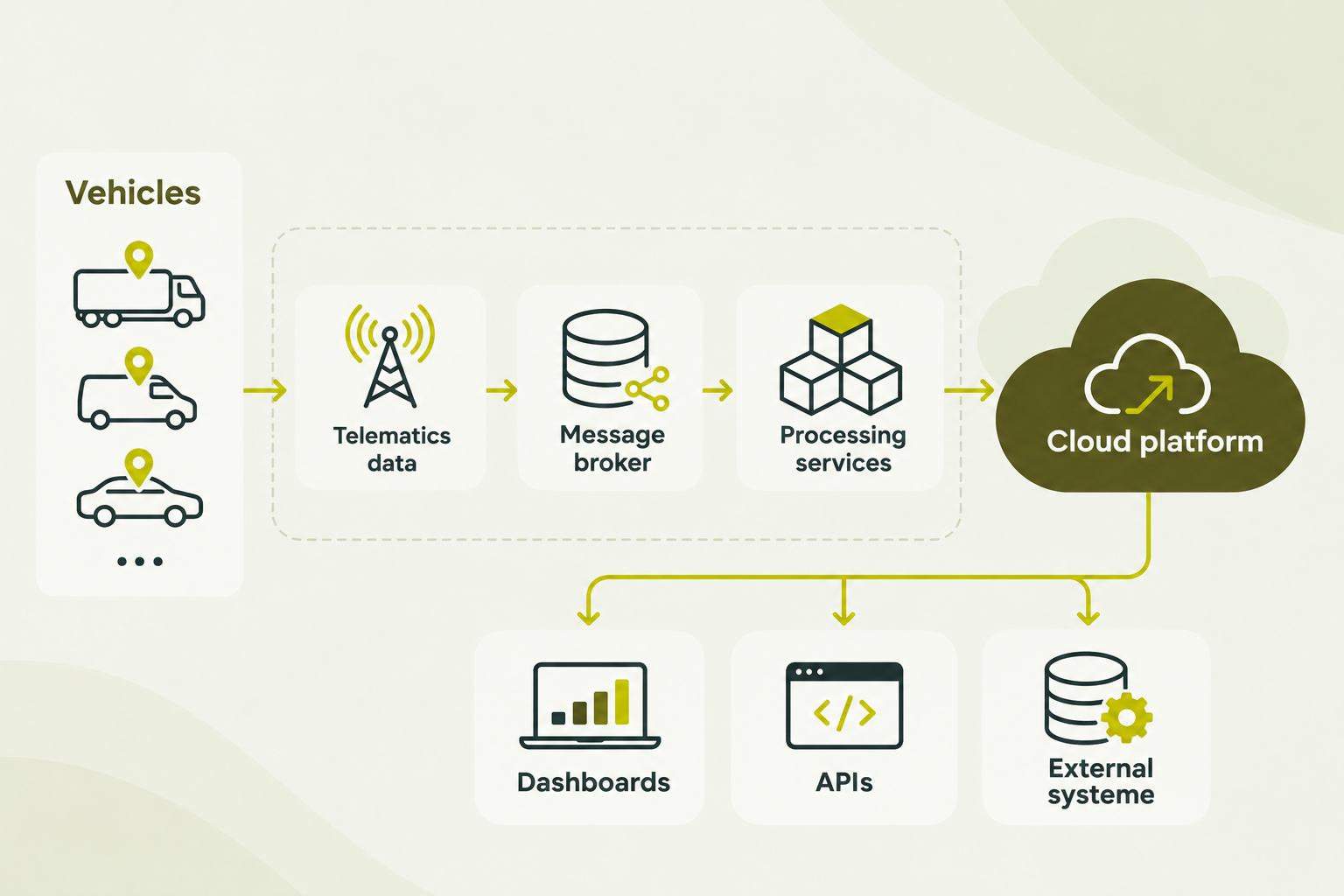
A fleet management platform experiences peaks in data traffic, such as when a large portion of the fleet is active at the same time. Depending on the scale and complexity, a modular architecture - possibly incorporating microservices and containers - can enable independent scaling of individual components. An event-driven architecture with a message broker helps handle peaks in telematics data. Combined with scalable cloud infrastructure, the platform can grow without requiring a complete rebuild with every expansion.
By defining the infrastructure as code (Infrastructure as Code, for example, using Terraform and Ansible), you also lay the foundation for reproducible environments. Development, test, acceptance, and production environments are set up in the same way. This makes changes more traceable, reduces environmental differences, and simplifies recovery and management.
Monitoring reliable integrations
It is precisely these numerous connections that make automated testing especially valuable. Every integration with telematics hardware, a mapping service, a fuel card provider, or an ERP system represents a potential point of failure. A change in one place can have unexpected consequences for another part of the chain.
With a layered testing strategy - including unit, contract, integration, and end-to-end tests - you can catch many errors before they reach production. For external systems you don’t manage yourself, you can use simulations, mocks, and separate test environments. The tests run automatically as part of the pipeline, so that with every change, you can quickly see whether the components are still working together correctly. This improves code quality and gives teams the confidence to release more frequently and in a more controlled manner.
Security and monitoring with DevSecOps
Because a fleet management platform processes sensitive data, security isn’t an afterthought but a prerequisite. In a DevSecOps approach, you incorporate security, logging, and monitoring requirements right from the design phase. Automated checks for code, software dependencies, secrets, and infrastructure are integrated into the pipeline. You can then roll out and validate security updates and patches in a controlled manner.
This is also relevant to laws and regulations. Location and driver data may constitute personal data. Under the GDPR, you may not retain this data longer than necessary for the purpose and must secure it appropriately. In addition, European regulations regarding driving and rest times and tachographs apply. Depending on the organization’s activities, sector, and size, the Cybersecurity Act - the Dutch implementation of NIS2 - may also be relevant. This law has now been enacted and will take effect on August 15, 2026. By translating these requirements into access controls, retention policies, audit trails, and incident procedures, you can avoid the need for costly retroactive adjustments.
No platform is completely free of incidents. The difference lies in the speed with which you identify, investigate, and resolve a problem. Monitoring and observability combine metrics, logs, traces, and targeted alerts. This provides real-time insight into the system’s health, and anomalies are often detected before they significantly impact users.
If something does go wrong during an update, a rollback or a targeted fix-forward can limit the impact. This works best when releases are managed through version control and application and database migrations are designed to be backward-compatible. You can then first restore service and subsequently investigate the root cause without undue time pressure. For a business-critical platform, where downtime has immediate consequences for operations, this is a significant advantage.

Measuring DevOps performance with DORA metrics
DevOps performance is measurable. DORA, the DevOps Research and Assessment program, uses five metrics for software delivery: deployment frequency, change lead time, failed deployment recovery time, change failure rate, and deployment rework rate. Together, they show how often you release, how quickly a change reaches production, how quickly you recover from a failed release, what percentage of changes cause problems, and what percentage of deployments are unplanned and intended to resolve issues.
These figures make it possible to discuss software development and management performance outside the IT team. Combine them with technical metrics, such as availability, response time, and error rates, as well as business metrics that matter to operations. This allows you to better assess whether investments in automation are paying off and where the next improvement step will deliver the most value.
Together, all these elements deliver a tangible business benefit. DevOps integrates design, development, and maintenance into a single, cohesive process. Decisions regarding architecture, security, data processing, and recoverability are made early on and continuously evaluated. As a result, the platform is not only developed more quickly but is also easier to scale, secure, and maintain.
For you as a client, this translates to shorter lead times, higher availability, and lower operational risks. The platform can continue to perform as your fleet and data volume grow, while allowing you to respond more quickly to new customer demands and market opportunities. A DevOps approach is therefore not merely a technical detail, but a strategic choice that directly contributes to the continuity and growth of your organization.
DevOps for your fleet management platform?
Do you want to release updates faster without compromising availability, security, or scalability? NetRom helps design and implement DevOps for mission-critical fleet management software - from CI/CD and cloud infrastructure to observability, security, and reliable operational management.
Explore our Cloud & DevOps expertise or contact us for a no-obligation consultation about your fleet management platform.