

The landscape of web technologies continues to evolve rapidly, driven by the need for more efficient communication, real-time interaction, and advanced user experiences. Protocols that enable data exchange play a central role in this transformation, supporting applications that range from business collaboration platforms to emerging IoT ecosystems.
Collaboration tools such as Microsoft Teams, Slack, and Discord illustrate this trend clearly. Their widespread adoption demonstrates how integrated messaging, video conferencing, live streaming, and increasingly, voice-assisted features, are reshaping the way organizations conduct meetings, share information, and manage daily workflows.
WebRTC vs. MQTT
Web Real-Time Communication (WebRTC) and Message Queuing Telemetry Transport (MQTT) are both open standards designed to support communication over networks. Despite being used in a variety of modern applications, their roles and underlying architectures differ significantly.
This article examines the characteristics of both technologies, outlines their respective strengths and limitations, and highlights the scenarios in which each is most effectively applied. The goal is to provide a clear understanding of how WebRTC and MQTT can be used (individually or in combination) to support reliable, scalable, and efficient communication in contemporary software systems.
What is WebRTC?
Web Real-Time Communication (WebRTC) is an open-source framework that enables direct, real-time communication between devices using standard web browsers and mobile applications. It supports the transmission of audio, video, text, and arbitrary data without requiring additional plugins or intermediary software.
Developers can integrate WebRTC through a set of JavaScript APIs, which provide functionality for:
- Accessing and capturing video, audio, and text data from user devices
- Establishing, managing, and terminating peer-to-peer connections between browsers or applications
- Transmitting data simultaneously across multiple channels
The core principle behind WebRTC is peer-to-peer communication. By allowing devices to exchange information directly, it reduces latency and minimizes reliance on external servers for data transfer. This makes it particularly suitable for use cases that require low-latency, two-way communication, such as video conferencing, file sharing, messaging platforms, and collaborative online tools.
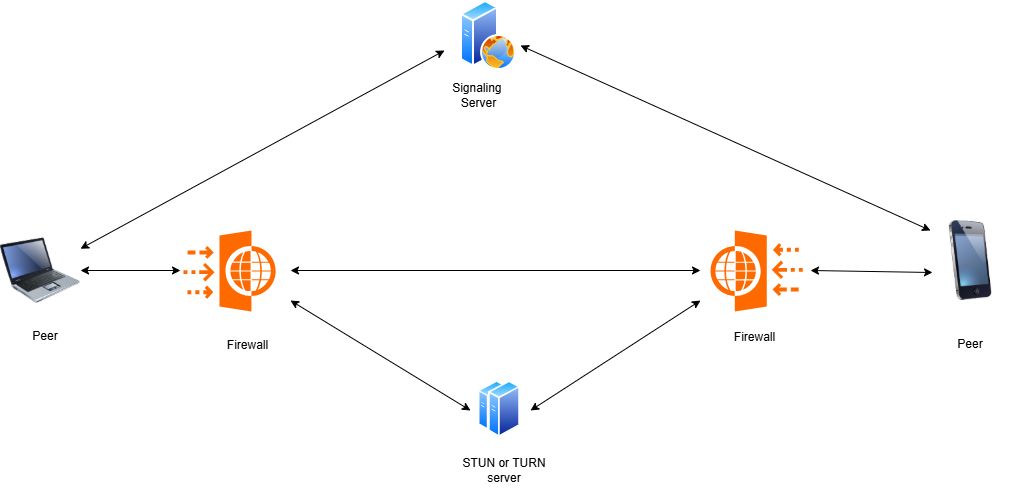
Privacy is a central element of WebRTC’s design. WebRTC requires encryption of audio, video, and data in transit. Media is protected using SRTP, while data channels use SCTP over DTLS.
Beyond peer-to-peer communication, WebRTC is also widely used in live streaming and broadcasting. Its low-latency characteristics make it well-suited for applications that require near real-time delivery of video content, including live events, online gaming, and interactive media.
From a compatibility perspective, WebRTC is supported by all major web browsers and has native integration across the primary mobile platforms. This broad support simplifies implementation and increases accessibility for end users. For an up-to-date overview, see WebRTC browser support.
What is MQTT?
MQTT is a lightweight messaging protocol designed for devices with limited power or memory, and for use in environments with slow or unstable internet connections. It is built to handle scenarios where messages may be delayed or occasionally fail to arrive.
At the core of MQTT are topics and subscriptions. Topics function like channels, arranged in a tree-like structure with segments separated by slashes (for example: Myhome/livingroom/light1).
When a device subscribes to a topic, it notifies the central MQTT broker (server) that it wishes to receive messages published to that topic. The broker records this request and ensures that any new messages sent to the topic are delivered to the subscribed device.
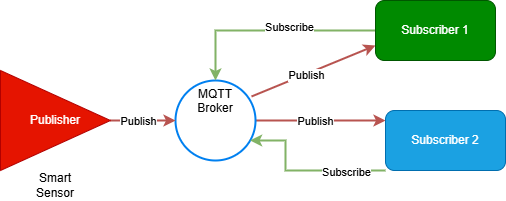
Another important element of MQTT is Quality of Service (QoS), which helps ensure message delivery even under unreliable network conditions. MQTT defines three QoS levels: 0, 1, and 2 allowing applications to choose the required level of delivery assurance. MQTT supports persistent sessions and session state that can help clients resume communication and reliable message delivery after reconnecting, depending on the client and session configuration. lost.
WebRTC vs MQTT: key differences
WebRTC and MQTT differ significantly in their intended purpose, transport mechanisms, messaging models, and application domains. The table below summarizes their main distinctions:
| Feature | WebRTC | MQTT |
|---|---|---|
| Intended Purpose | Real-time media and data communication | Lightweight messaging for IoT and machine-to-machine (M2M) communication |
| Transport | RTP/SRTP for media; SCTP over DTLS for data channels, typically over UDP | Primarily TCP; also supports WebSockets and MQTT-SN |
| Messaging Pattern | Peer-to-peer (direct or via SFU/MCU) | Publish/subscribe (via broker) |
| Typical Use Cases | Video/audio calls, live streaming, IoT media applications | Sensor data, device control, notifications |
| Overhead | Higher, especially for session setup and media transmission | Very low, optimized for constrained devices |
| Reliability/QoS | Prioritizes real-time delivery; data channels can be reliable | Configurable QoS levels (at most once, at least once, exactly once) |
| Security | Mandatory encryption of media and data channels; signaling is implemented by the application | TLS/SSL encryption and various authentication options |
Applications of WebRTC and MQTT
Both WebRTC and MQTT are widely adopted, but their applications differ based on the type of communication they are designed to support.
WebRTC applications
WebRTC is primarily used in industries and platforms that require real-time communication, such as video conferencing, live streaming, and collaborative tools. Prominent examples include:
- Google Meet: Uses WebRTC for peer-to-peer audio and video communication.
- Zoom: Relies on WebRTC for meetings accessed through web browsers.
- Facebook Messenger: Implements WebRTC to provide real-time voice and video calls.
- Discord: Employs WebRTC for live voice and video interactions, particularly popular among gaming communities.
- Airbnb: Uses WebRTC in its “online experiences” feature to enable live user interaction.
These examples demonstrate WebRTC’s role in enabling low-latency, interactive communication directly between users.
MQTT applications
MQTT, by contrast, is optimized for the Internet of Things (IoT) and machine-to-machine (M2M) communication, where devices often have limited resources and rely on efficient data transmission. Its lightweight publish/subscribe model makes it well suited for connecting a wide range of devices, including thermostats, appliances, security systems, wearables (such as smartwatches, fitness trackers, and health monitors), and smartphones.
The advantages of MQTT extend beyond standardization. Its low protocol overhead can reduce bandwidth and energy usage, which is particularly relevant for resource-constrained devices.
Notable examples of MQTT in practice include:
- Smart Cities: IoT infrastructure for smart cities increasingly relies on MQTT for device communication. The global IoT in Smart Cities market was valued at approximately USD 182.07 billion in 2024 and is projected to grow to USD 214.11 billion in 2025, with a compound annual growth rate of 17.12%, reaching USD 469.96 billion by 2030.
- Facebook Messenger: Facebook adopted MQTT instead of HTTP for its mobile applications, as they share characteristics with IoT workloads: intermittent connectivity and the need to reduce battery consumption. MQTT’s topic-based publish/subscribe model supports group chats efficiently, treating each chat as a distinct topic.
- Instagram: Uses MQTT for push notifications and related features.
- Automotive: BMW built its car-sharing platform, managing over 14,000 vehicles across 18 cities, on top of MQTT.
- Asset Tracking and Logistics: MQTT is widely used to monitor assets in real time. If connectivity is lost during transmission, the protocol ensures reliable delivery once the connection is restored.
Implementing WebRTC
Developers can accelerate WebRTC implementation by using a range of supporting libraries, which simplify connection management and extend functionality:
- Socket.io: Useful for managing signaling and connections.
- SimplePeer: Provides a simplified interface for working with WebRTC.
- Twilio Video: Provides managed video infrastructure and APIs for building scalable video applications.
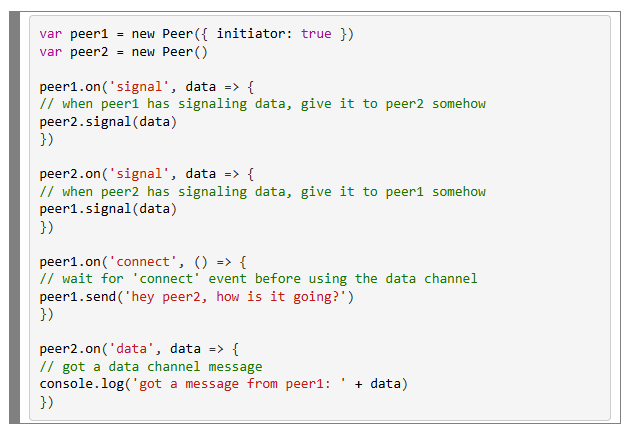
Among these, SimplePeer is often preferred for its simplicity and ease of adoption. It is an open-source library under the MIT license with a relatively simple API and practical examples. . This makes it a suitable entry point for developers new to WebRTC.
The setup process is straightforward and typically involves three steps:
-
Install the library in the project.
-
Create a connection using a
Peerobject.
-
Begin transmitting video, audio, or binary data.
For example:
Twilio provides a professional-grade solution that extends beyond a simple library by offering a complete ecosystem for building scalable, production-ready video applications. Its platform includes:
- Built-in support for TURN/STUN servers for reliable connectivity
- Seamless integration with other Twilio services, such as SMS and authentication
- Extensive documentation and SDKs for multiple platforms
By managing complex aspects of WebRTC infrastructure, including NAT traversal, signaling, and server maintenance, Twilio reduces the implementation burden for development teams. This abstraction enables faster deployment of real-time communication features while maintaining reliability and scalability.
It should be noted, however, that Twilio Video is a commercial service with usage-based pricing.
Implementing MQTT
At the core we have MQTT brokers and MQTT clients.
The senders don’t send the messages directly to recipients, but instead they use an MQTT broker. This way, MQTT clients publish data to the broker, which then distributes it to subscribed clients based on a predefined topic. Each message contains a topic identifier, enabling clients to subscribe to only the topic of interest. The broker keeps a list of subscribers, and based on that list, it sends the messages to the appropriate clients.
There are many open-source MQTT clients available covering many programming languages. HiveMQ maintains an overview of MQTT client libraries for multiple programming languages. Some popular MQTT client libraries include:
- MQTT.js: JavaScript MQTT client for Node.js and the browser
- Eclipse Paho MQTT Java Client: Java MQTT client library
- HiveMQ MQTT Client for .NET: C# MQTT client for .NET
For a broader overview, see EMQX's overview of MQTT client SDKs.
Before proceeding, ensure that you have an MQTT broker to communicate and test with. There are several options for obtaining an MQTT broker:
- Private deployment using Docker using one of the docker images from EMQX
- Fully managed cloud paid service
- AWS IoT Core provides managed MQTT connectivity for IoT devices and applications
- Azure Event Grid provides a managed MQTT broker for IoT messaging
- EMQX Serverless
- HiveMQ provides a public MQTT broker for testing and demos
After we have the broker, we can create the clients that are going to be connected to it.
Let’s use the MQTT.js library, which can be installed easily by running the npm install mqtt command. Then we create the client instance:

The role of a broker is to relay messages to clients, maintaining a separate connection for each one. Each device only needs to establish a single connection with the broker in order to share data with many other devices. For example, HiveMQ’s MQTT broker can support up to 200 million connections.
Before accessing a broker, authentication is required. To illustrate this, let’s adjust the code example slightly:
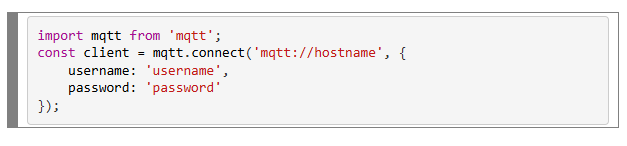
And now let’s send the classical Hello World with MQTT.

We can subscribe to MQTT messages using the subscribe method:

The implementation shown above is a very basic example. Before deploying to production, configure appropriate security measures such as TLS, authentication, authorization, and secure credential or certificate handling. This is important because MQTT is designed to exchange data between IoT devices as efficiently as possible, rather than to provide strong security by default.
For a complete Node.js example, see HiveMQ's guide to using MQTT with Node.js.
Conclusion
There is no definitive “winner” between WebRTC and MQTT, as each serves a distinct purpose within the technology ecosystem. In fact, many large platforms, such as Facebook Messenger, use both: MQTT for signaling and message delivery, and WebRTC for video, audio, and file sharing.
The decision to use WebRTC, MQTT, or a combination of both should be guided by the specific requirements of the application. That choice is also part of a broader architectural decision between synchronous and asynchronous communication patterns. For applications where direct audio, video, or peer-to-peer data communication with low latency is central, WebRTC is a natural choice. For scenarios involving low-power devices or unreliable networks, MQTT is often more appropriate, particularly in IoT environments.
Ultimately, these technologies are not direct competitors. When used together, they can enable real-time solutions that are both scalable and efficient.
Building an application with real-time communication, event-driven messaging, or external integrations? Explore our Frontend UI and Backend Engineering expertise, or discuss with our engineers which architecture best fits your use case.

WebAssembly: Revolutionizing web development

Web Speech API: Building voice-driven web experiences