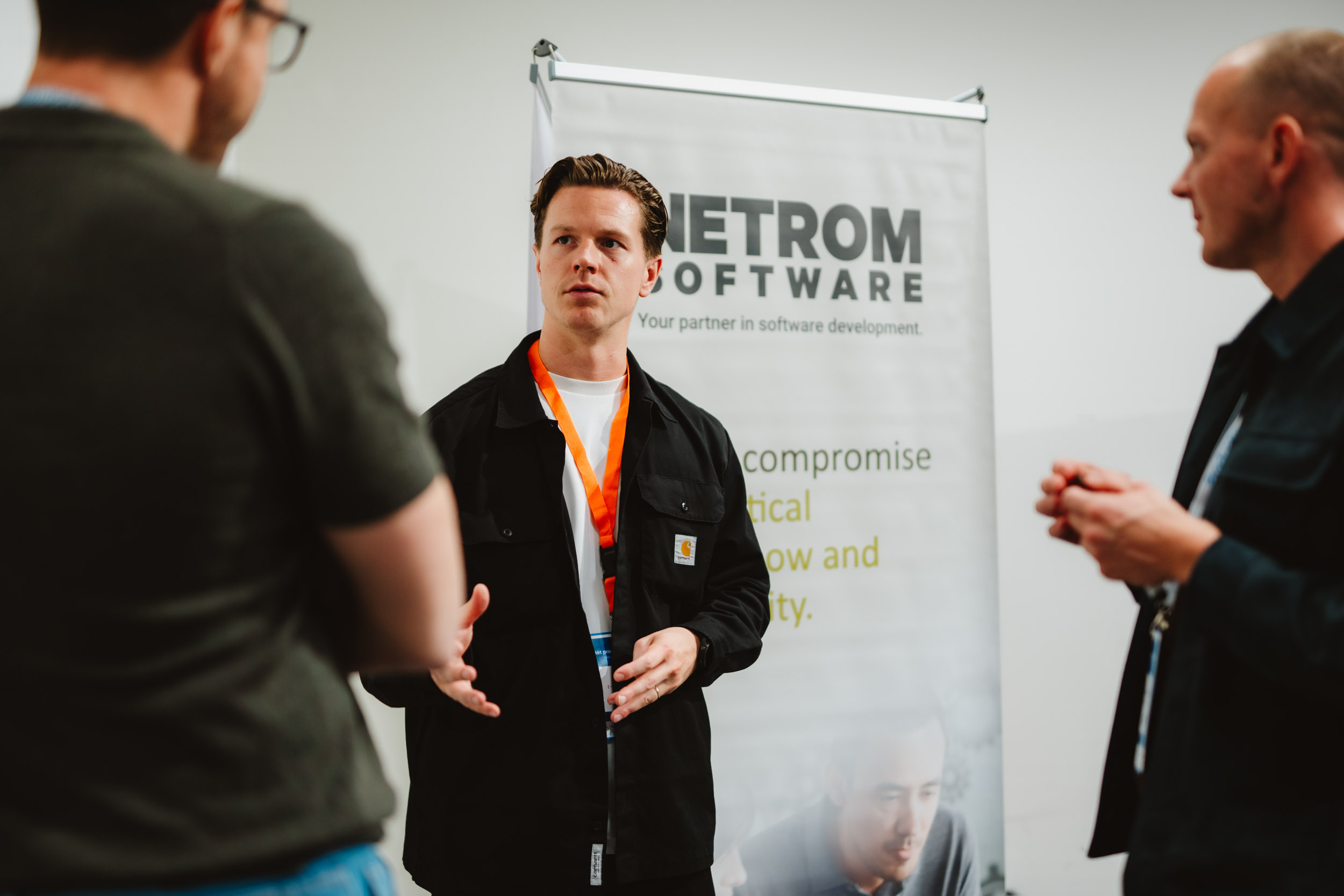

AI-assisted coding has become indispensable, while agentic AI is rapidly emerging as the next step. But what does that mean for how you assemble and scale a development team? In a new episode of the NetRom podcast, Jaap Merkus (CEO of NetRom Software) and Edwin Zenderink (former SVP of Technology at BlueConic) discuss this topic. Their conclusion is straightforward: technology is evolving at breakneck speed, but to successfully integrate AI into your development process, you still need a strong team.
For many IT decision-makers, AI in software development raises the same question: the tools are becoming more powerful by the day, but how do you deploy them without losing control over quality, costs, and governance? What does that require of your people, too? Jaap and Edwin share their real-world experiences and provide an honest picture of what works, what sometimes goes wrong, and what you need to watch out for.
From assistant to agent
As moderator, Anneke van der Putten, Sales Director at NetRom Software, opens the discussion by noting that we’re now seeing a shift from AI-assisted coding to vibe-coding and agentic AI. Does Edwin recognize that picture? “AI-assisted coding is really the bare minimum these days, and the future is agentic,” he says. Jaap sees that reflected at NetRom: “In our company, about 90 to 95 percent of developers now use the coding assistant continuously. You see a little improvement every day, and there’s no end in sight.” No spectacular leaps, but continuous improvement that pays off big in the long run.
Edwin sees vibe coding—the rapid creation of a prototype without in-depth technical knowledge—primarily as a tool for innovation. “You can create a prototype based on what you already have without much programming knowledge. That gives companies the opportunity to test ideas much more easily. For complex, full-stack challenges, agentic AI is the methodology that really matters.”
Agentic AI is a system, not a tool
“So what are the pitfalls?” asks Anneke. Edwin makes a point that he believes is often underestimated: “Agentic engineering is really about developing a system. You first have to build that system, but you also have to maintain it and continuously improve it. That’s at least as complex as software engineering itself.” Setting something up once is quick, he says, but the real challenge is to systematically improve the system and incorporate your engineers’ ideas into it.
That requires a different mindset. “It’s really a shift in philosophy and culture within your engineering organization,” Edwin summarizes. An agent only works well with the right instructions and context, and every time something goes wrong, you learn from it. That’s precisely why you need experienced engineers who understand what’s happening under the hood.
The code was never the bottleneck
One of the most striking insights turns the common assumption on its head. “Coding was never the problem,” Edwin says matter-of-factly. A good engineer spends only a limited portion of their time writing code. Jaap elaborates: “We’ve estimated that the actual writing takes up about 10 to 30 percent of the time. The rest of the time is spent thinking through and coordinating what you’re going to write.”
It is precisely that writing work that AI speeds up enormously. But the bottleneck doesn’t disappear. It shifts. “Whereas the bottleneck used to be centered on coding, it’s now more at the front end and the back end,” Edwin explains. At the front end: which idea should you even build? At the back end, more software also brings with it greater operational complexity, as well as security and compliance issues. “More software is never the goal,” he emphasizes. Bringing the right idea to market is.
Jaap recognizes a familiar pattern here. Software projects have traditionally run into trouble in three areas: too late, too expensive, or not according to specifications. Those who improve on these three fronts with AI will reap the greatest rewards. At the same time, he sees an opportunity: “Now that development is becoming more accessible, companies will hopefully be more willing to opt for custom software. That way, you get exactly what suits your needs, rather than an expensive off-the-shelf product.”
Teams consist of people and agents
Anneke wants to know how this changes the composition of a team. “I think all teams, whether now or in the future, will consist of people and agents. That’s inevitable,” says Edwin. Such an agent does have its quirks: “An agent has no feelings, so it doesn’t show up to work in a bad mood. It’s always the same, and it works 24 hours a day.” But the core of a successful team remains the same as it was ten years ago: clear ownership, well-defined responsibilities, the courage to learn, and, above all, mutual trust.
That trust translates to the agents. In a proof of concept, NetRom had agents autonomously follow the steps of an engineer, with each agent documenting in a ticket what they did and why. This allows an engineer to reconstruct afterward how a result was achieved. If something goes wrong, that’s not a reason to point fingers, but a learning opportunity. “It’s okay to make mistakes. Things will go wrong from time to time, and that’s fine,” says Edwin, referring to the blameless postmortem: working together to identify areas for improvement.
That transparency isn’t optional. You need it from day one, including for your governance. The agents don’t have to be perfect right away, but you must always be able to follow their line of reasoning. Edwin sums it up practically: “Make sure your agents are simply listed in your organizational chart. That way, you know exactly what expertise is available.”
Beware of lock-in and technical debt
The conversation gets serious when it comes to risks. As soon as your system of agents builds and maintains your software, those agents themselves become part of your software. An agent configured around models from six months ago can do different things than an agent based on the latest models.
“I wouldn’t advise companies to go 100 percent with agents right now. I guarantee you’ll have technical debt in your agents in a year and a half. If you go all-in on a single tool or model, you’ll soon be stuck with costs you can’t even foresee right now.” Moreover, those costs are rising as licensing models change; budgeting for them has now become a fixed part of the IT budget. Anneke asks if there are already companies going all-in. There are, both speakers confirm.
Still, waiting it out isn’t an option, Jaap emphasizes: “Doing nothing with AI is definitely not an option, because you have to figure out what works for you. Invest in specific areas, experiment, stay flexible, and maintain a degree of digital sovereignty by not becoming dependent on a single vendor.”
The engineer’s role is expanding
What does this mean for your people; and especially for young talent who are starting out directly with AI? Understanding what’s happening technically remains essential. “Sometimes you just have to say: we’re not going to use agents for now; we’ll build something ourselves and see how it works. Because you really need to understand what’s going on under the hood,” says Edwin. “Only then can you assess whether the result meets security, compliance, and quality standards.”
At the same time, the focus is shifting. “We used to think long and hard before we started building. We called that ‘think to build.’ We’ve flipped that to ‘build to think,’” explains Edwin: first experience the technology to discover what’s possible. This broadens the engineer’s role. “Communicating, aligning, documenting, coordinating, and talking with the business have become more important,” adds Jaap. At NetRom, this translates into targeted investments in the NetRom Academy, where young developers acquire these skills alongside their technical foundation.
The power of a good development partner
“You rarely scale up on your own,” Anneke points out. External partners provide extra capacity and give your own team room to experiment and get to know the technology. According to Edwin, the real value lies in two things: “One of the strengths of a partner is that they can bring in expertise you don’t have yourself.” It’s crucial that this knowledge sticks: a good partner leaves your team stronger than they found it. In addition, the partner must thoroughly understand your domain, not just the technology.
That aligns with how NetRom views collaboration. “Entering into a partnership on a whim is self-defeating,” says Jaap. Precisely because agents become an integral part of your software, it’s crucial to agree together on how to safeguard and transfer that knowledge. This also helps prevent shadow IT. “If something can be built very quickly by a cowboy team, you lose track of the big picture,” warns Jaap. You have to be able to control something powerful; otherwise, it gets out of hand.
Start small, think like a system
To wrap up, Anneke asks how to successfully scale up with AI, with partners, and with your own team. The message from both speakers is simple but powerful. “Above all, you have to get started. Start small, iterate quickly, and design your entire process around learning. From day one, view it as a system, not as a set of separate tools,” Edwin summarizes. Jaap agrees: “Learn, experiment, don’t wait around. Just do it. Also, stay a little agile so you can pivot as soon as you see what works.”
Edwin concludes with a telling observation. The problems you encounter along the way often have little to do with technology: “They’re usually organizational problems in disguise.”
Watch or listen to the full conversation
This article summarizes the main points, but the full conversation is packed with many more real-world examples, nuances, and insights. Want to hear what Jaap, Edwin, and Anneke have to say about trust in teams, the pitfalls of agentic AI, and the future role of the engineer? Then watch or listen to the full podcast episode below. You can also listen to the podcast via Apple Podcast , or Spotify.
Please note!
You currently cannot view this video because you have not accepted the required cookies. Would you like to watch the video on the website? Please adjust your cookie settings and accept marketing cookies.

Curious about how we can help your development team scale up in the AI era, striking the right balance between speed, quality, and manageability? Explore all our services or feel free to contact us for a no-obligation consultation. We’d love to brainstorm with you about the possibilities in the field of AI.
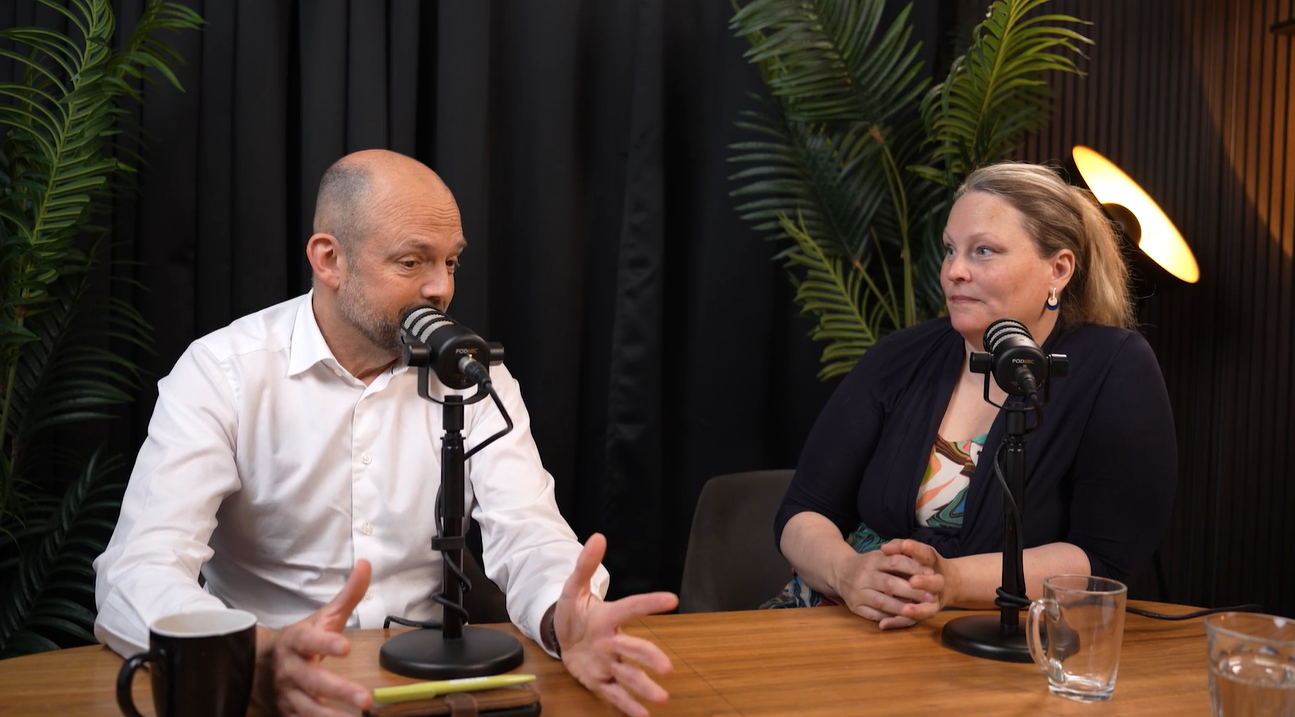
Jaap Merkus: “Sometimes you have to slow down a bit, take a step back, and then take two steps forward”

Jaap Merkus on the future of software development: “AI makes good developers even better”