

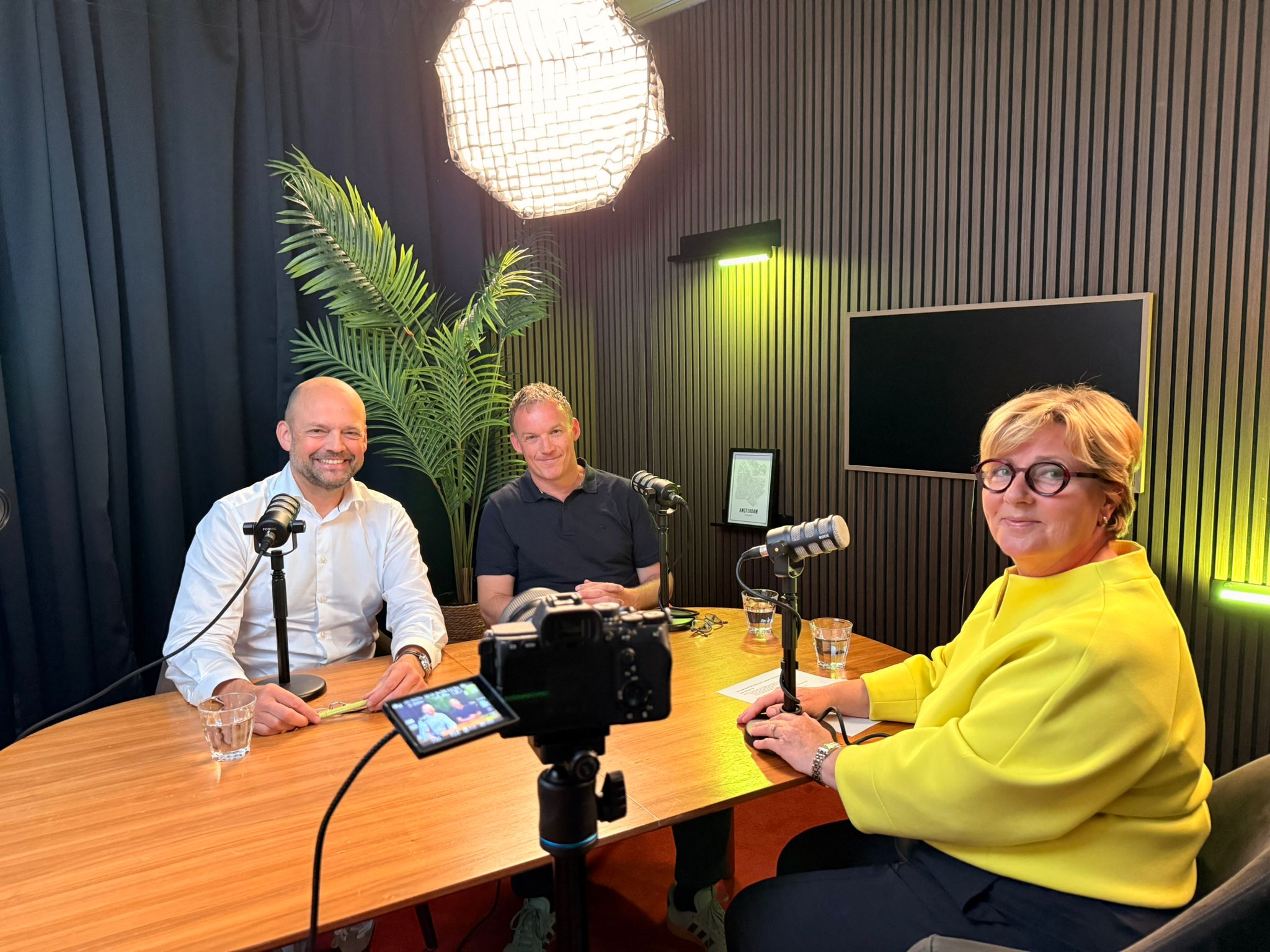
A roadmap that keeps shifting, deadlines you have to reschedule, releases you have to keep postponing: almost every CTO and CIO can relate. Complexity often gets the blame, but the real causes are usually much more practical. In our podcast, Ingrid den Uijl, Head of Product Development at transportation company Transdev Nederland, and Jaap Merkus, CEO of NetRom Software, discuss why delivering predictable results in custom software development can be a challenge.
Anneke van der Putten, Sales Director at NetRom Software, serves as moderator for this podcast. She begins by outlining how things play out in practice: too much work in progress, dependencies that don’t surface until late in the process, and low velocity. These are all bottlenecks that quietly derail your planning and rarely have anything to do with technical limitations. Much more often, it comes down to how teams, the business, and suppliers work together. That is precisely where the opportunity lies to regain control of the roadmap.
Why roadmaps almost always slips
According to Ingrid, the problem stems from a lack of overview. She follows a simple rule of thumb: a developer’s estimate is always pure development time. To arrive at a realistic delivery date, she multiplies that by two and adds two weeks, because testing, waiting for input, and unforeseen work all come on top of that. “It’s always ‘happy day’ planning, but that’s not the real world, because things never go right the first time,” she says.
Jaap points out that changing business needs often come on top of that. “Everyone plans for success, really. Planning for the things that can go wrong is a lot less fun,” he says. And even with a buffer, the plan quickly turns out to be too expensive or too slow, after which you’re still pushed toward the optimistic scenario. “If you’re nothing but pessimistic, you won’t get anything off the ground either. So it’s a balancing act.”
Too much at once and too many dependencies
Anneke wants to know what too much work in progress looks like in practice. As soon as too many things are happening at once, everyone divides their attention among multiple tasks, Ingrid warns. “Things that run in parallel always seem to go wrong at the same time, one way or another.” Instead of focus, you end up constantly switching gears: re-reading, switching contexts, hours that just evaporate throughout the day.
On top of that, there are the dependencies. “What’s deadly for your planning are the dependencies you didn’t see coming,” says Ingrid. An experienced team, a clear architecture, and sharply defined requirements and user stories help you plan for those in advance. Some factors remain external and can’t be sped up.
Jaap sees how taking shortcuts pushes the problem forward until panic sets in. “When it piles up, you end up with a sort of shadow backlog. The team is aware of it, but it’s not explicitly documented anywhere,” he says. His advice: sometimes you have to slow down a bit, take a step back, and then take two steps forward.
Quality requires agreements and checks
Anneke argues that quality issues rarely stem from a lack of talent, but rather from a lack of agreements. Ingrid qualifies that: it’s not just about the agreements regarding quality and work methods, but primarily about the checks you put in place. The basic rules for quality and security—such as not hard-coding passwords—are easy to implement. “The hardest part is ensuring that you actually have controls in place for them,” she explains. She advocates for “testing by design,” because without a test scenario, you don’t even know what you’re developing toward.
Jaap emphasizes why a quality-first mindset should be embedded in the team from the start. If testing is only brought in at the end and your roadmap shifts, the planned ratio of 80 percent development and 20 percent testing quickly shifts to 90/10: the testing work gets pushed aside. “A quality-first mindset must be an integral part of the team, not just in the tester’s head,” he says.
Saying no, being transparent, and continuing to measure
Predictability starts with doing fewer things at once and having the courage to say no, Ingrid notes. The business almost always wants more than IT can deliver—and in less time. The classic “you just need to tweak that” overlooks what lies beneath: a single modified variable can easily affect seventy-five reports. She seeks her solution not only in transparency and ownership but also in breaking down the divide between IT and the business. It has to be one team.
According to Jaap, stopping measurement would be a misguided reflex. “Even if you’re only 85% accurate: bring in transparency and learnings. Measure correctly,” he says. Keep velocity, productivity, and accuracy visible; otherwise, the business will manage you purely based on time.
Ingrid applies that same principle when it comes to AI, a topic she’s deliberately critical of. Her first counter-question is invariably how you’ll demonstrate that development is becoming cheaper or that people are becoming more productive. “If we invest an extra 200 euros per person per month and our velocity stays the same, then something isn’t right.” Jaap puts AI into perspective: “The coding itself has never been a planning problem. It’s in the coordination around it.” If coding gets faster, other bottlenecks simply emerge.
Predictable rhythm and flow over heroics
Ingrid prefers to call a fixed rhythm of planning, review, and retro a “predictable rhythm.” She finds “fixed” too inflexible: vacations and holidays throw any tight schedule into disarray. For her, it’s not about the moment of delivery, but about the alignment and integration surrounding it. A predictable retro also creates a safe space where colleagues feel comfortable holding each other accountable.
Jaap adds a more qualitative indicator: flow. “If things move slowly one morning and super fast the next afternoon, you know something’s off,” he says. Constantly having to catch up under stress drains a team and pushes people toward shortcuts.
That’s why consistency trumps “hero mode.” In that mode, everything relies on one or two people, Ingrid explains. They’re then the only ones who can keep the work going. That’s how single points of failure arise. Jaap puts it this way: “Firefighters love fire.” Putting out a small fire feels heroic, but most of the time you actually need to take a step back.
Resolve the most critical bottlenecks
Rework always takes more time, but that doesn’t make it bad, Ingrid clarifies. If you want to avoid all rework, you’ll let the scope grow so large that a project becomes unfeasible. That’s why at Transdev they work with “fast track” and “safety track”: the fast track is allowed, as long as the safety track remains on the backlog. Jaap recognizes in this the discipline needed to achieve your goal pragmatically, “because otherwise, it’s the weakest link that sets the pace for the whole project.”
As a final question, Anneke wants to know what a CIO or CTO should do tomorrow. Ingrid doesn’t hesitate: eliminate dependencies and make everything as small as possible. If something is ready for release, actually release it, instead of waiting until the rest of your roadmap is complete. Jaap focuses on bottlenecks: “Bottlenecks are always there. Solve the two most important ones, and you’ll help a team move forward quickly.” Together, it boils down to four things: eliminate dependencies, be transparent, break work down into small pieces, and tackle bottlenecks.
Watch or listen to the full conversation
This is an excerpt from a more extensive conversation, which covers many real-world examples from NetRom Software and Transdev. Want to hear Jaap and Ingrid delve deeper into these topics? Then watch or listen to the full podcast episode below. You can also listen to the podcast as an audio file via Apple Podcasts , or Spotify.
Please note!
You cannot currently view this video because you have not accepted the required cookies. Would you still like to watch the video? Change your settings and accept marketing cookies.

Curious about how we can help your development team scale up in the AI era, striking the right balance between speed, quality, and manageability? Explore all our services or contact us for a no-obligation consultation. We’d love to brainstorm with you about the possibilities in the field of AI.
Jaap Merkus: “Doing nothing about AI isn’t an option: you have to figure out what works for you” [DUTCH PODCAST]

Jaap Merkus on the future of software development: “AI makes good developers even better”