

Product Owners operate in a dynamic environment. Competitors release new features on a weekly basis, end users expect continuous innovation, and technological developments evolve rapidly. As a result, the business expects Product Owners to deliver new functionality at an increasing pace. This creates high workloads that, sooner or later, lead to delays on the roadmap. Fortunately, nearshoring offers a way to address this challenge.
The National Product Owner Leadership Survey 2024 by ProductOwner.nl found that 38% of respondents said their roadmap was not on schedule. Frequently cited causes included lack of focus and prioritization, technical debt or legacy, changing stakeholder requirements, and unrealistic deadlines. This situation affects the entire organization: deadlines are at risk, stakeholders become frustrated and lose trust, and development teams are forced to perform under high pressure. As a result, the quality of output comes under significant strain.
A roadmap delay is therefore not automatically a capacity problem. Nearshoring is particularly relevant when insufficient development capacity or missing technical expertise is a significant bottleneck.
Why product owners fall behind on the roadmap
Roadmap delays present a major challenge for Product Owners. Three key causes can be identified: overly high expectations from management, overly optimistic planning, and insufficient budget.
- Overly high management expectations: Management often lacks sufficient insight into the complexity of the development process and is therefore too optimistic about timelines or functionalities.
- Overly optimistic planning: Product Owners sometimes create unrealistic schedules because they do not account for unexpected setbacks. Examples include scope creep, technical challenges, and new compliance requirements.
- Insufficient budget: Budget constraints often result in limited resources, putting pressure on areas such as maintenance and documentation. This creates a vicious cycle that increases workload and raises quality risks.

Why working harder does not solve roadmap delays
When delays occur, organizations are often inclined to have development teams work harder and on multiple tasks at the same time. This approach usually backfires. Because of the fragmented way of working, teams must constantly switch between tasks, which results in significant efficiency loss.
Quick or temporary software solutions can create technical debt, which may lead to additional maintenance and delays over time. This causes teams to lose motivation and perform worse, creating a downward spiral that only reinforces the original problems.
How to address roadmap delays structurally
For Product Owners, a roadmap delay means the need to consider a different approach. This can be done in three steps.
Step 1: Make the capacity problem visible
- Turn an invisible problem into something tangible with solid data.
- Analyze how much work a team can realistically deliver compared to what is expected.
- Show which revenue or cost savings are lost due to postponed feature development.
- Quantify the time and money spent on fixing problems, rework, and technical debt.
These figures clarify the impact on the business and demonstrate that the solution does not lie in working harder, but in structurally addressing the root causes of the delays.
Step 2: Take inventory of all development activities
Development tasks differ in terms of complexity and repetitiveness. By mapping tasks in a structured way, it becomes possible to organize their execution differently depending on the type of work.
We can distinguish four categories:
- Low complexity, low repetitiveness: Simple and infrequent tasks that can be performed or outsourced with ease.
- Low complexity, high repetitiveness: Routine activities that are suitable for automation or outsourcing.
- High complexity, low repetitiveness: Complex, strategic activities that deliver significant value.
- High complexity, high repetitiveness: Complex tasks that frequently occur within the development process.
Step 3: Organize the execution of tasks
Once all development activities have been clearly mapped, an organization can develop a strategy for the most effective allocation of resources. There are several options for carrying out tasks: automation through AI technology, expanding the internal team, hiring freelancers, or outsourcing via offshoring and nearshoring.
The right choice depends on the nature and complexity of the work, available budget, desired timelines, required quality standards, and the knowledge needed.
Automation with AI
Repetitive tasks are well-suited for automation. For work with low complexity and high frequency, test scripts, AI tools, and workflow automation can deliver quick results. These solutions can reduce repetitive manual work and give development teams more room to focus on complex and strategic tasks. However, automation alone rarely resolves capacity issues completely.
Internal team expansion: costly and time-consuming
Expanding the internal development team can be an appropriate solution, but recruitment and onboarding require time and capacity. Although tightness in the Dutch ICT labor market has eased in recent years, qualified ICT professionals remain in demand. New employees also need time to become familiar with the existing codebase, processes, and domain knowledge.
Freelancers: flexibility at a high hourly rate
Freelancers can provide flexibility and specialized expertise. Rates vary considerably depending on expertise and experience. Continuity also requires attention: project-specific knowledge should be documented and shared when external professionals are temporarily part of the team.
Offshoring: lower costs, but practical challenges
Offshoring can provide access to large talent pools and different cost levels, but collaboration may become more complex when teams have limited overlap in working hours or significantly different communication and working practices. Data protection also requires attention: when personal data is transferred outside the European Economic Area, additional safeguards may be required under the GDPR. The practical impact varies by country, provider, and collaboration model.

When nearshoring helps with roadmap delays
An increasing number of Dutch organizations are deliberately choosing nearshoring. This approach combines the advantages of different outsourcing models, bringing together cost efficiency, operational reliability, and deep expertise.
Advantages of nearshoring:
- Quality: Access to well-educated IT specialists with relevant technical expertise and domain knowledge. Actual quality depends on the nearshoring partner’s selection, onboarding, and quality processes.
- T-shaped specialists: Specialists combine deep expertise in a specific discipline with sufficient broader knowledge to collaborate effectively across disciplines. This allows both specialized and broader development challenges to be addressed within the same team.
- Comparable work culture: When working with teams in nearby European countries, working hours, business context, and communication styles can often be aligned more easily. Cultural fit should still be actively assessed during partner selection and throughout the collaboration.
- Fast communication: Limited time-zone differences make daily alignment, stand-ups, refinements, reviews, and rapid feedback during the same working day practical.
- European legislation and regulations: When working within the EU/EEA, organizations operate within a shared European framework for data protection. Clear agreements on privacy, information security, intellectual property, and data processing remain necessary.
For product owners whose roadmap delays are significantly influenced by insufficient development capacity or missing technical expertise, nearshoring can provide a structural way to add capacity and knowledge to the development team.
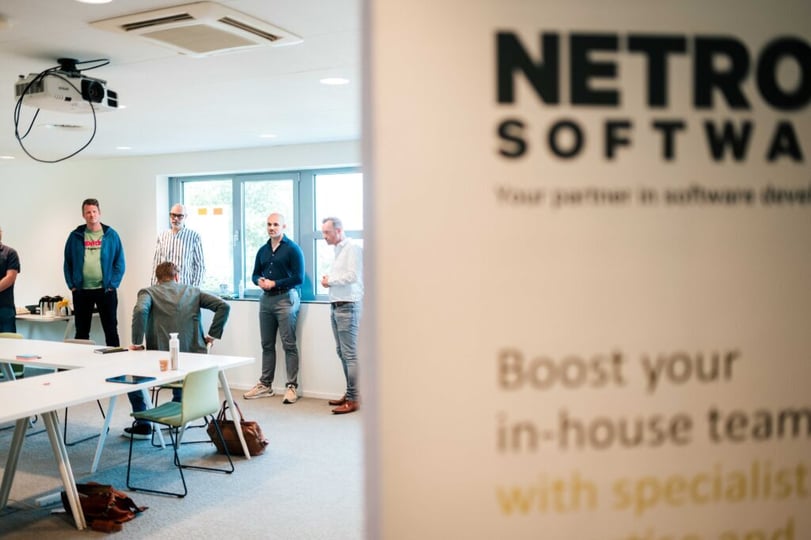
When nearshoring helps with roadmap delays
When selecting a nearshoring partner, several criteria are essential for ensuring a successful collaboration.
-
Communication as a foundation
Communication skills and strong proficiency in English form the foundation of effective nearshoring. Clear communication prevents misunderstandings about requirements and ensures smooth project execution. Without strong communication, issues can quickly arise that undermine the entire collaboration.
- Technical expertise and experience
A careful assessment of the technical capabilities of a potential nearshore partner is indispensable. First, the client should determine whether the partner’s technical expertise matches the project requirements. It is also important to verify whether the partner has relevant experience in the client’s industry and domain. A reliable partner can demonstrate concrete successes and references that validate their track record.
- Cultural fit with the nearshore partner
A strong cultural fit forms the basis of a sustainable collaboration. This includes alignment on communication styles, shared quality standards, and a joint approach to challenges.
When there is a strong fit, the external team feels like a natural extension of the client’s own organization. This results in seamless collaboration, enabling both parties to work efficiently within a familiar and shared structure.
Starting safely with nearshoring
For Product Owners unfamiliar with nearshoring, a phased approach is advisable. It is recommended to start with a small pilot project (Proof of Collaboration - POC) to gain experience. In such a project, the Product Owner can assign the external development team a non-critical feature to minimize organizational risks.
Why a Proof of Collaboration?
- Mutual introduction: Both parties become familiar with each other’s ways of working, culture, and expectations.
- Quality assessment: Direct experience with technical solutions and the project approach.
- Process validation: Testing whether development processes align with the organization’s requirements.
- Trust building: Working together on real assignments fosters mutual trust.
- Risk minimization: A small initial assignment limits risks for both parties.
A Proof of Collaboration can help assess technical skills, communication patterns, reporting structures, quality control, and alignment with existing workflows. After a positive evaluation, the client can consider assigning larger projects to a nearshore partner.
The role of the Product Owner in nearshoring
When an organization chooses nearshoring, the Product Owner plays a constructive role. The responsibilities of a Product Owner in this context can be divided into four categories:
- Task allocation and planning: Determine which tasks (such as complex, strategic decisions) remain in-house and which can be outsourced to the external nearshore team.
- Ensuring security: Establish clear agreements on cyber security, ensure compliance with privacy regulations, and implement secure development practices.
- Creating team cohesion: Organize regular online meetings, joint evaluations, and site visits so that the client and the nearshore team get to know each other.
- Remote guidance: Provide clear documentation, frequent status updates, and one-on-one support for individual developers.
Eliminating roadmap delays?
Falling behind on your roadmap and development capacity is a key bottleneck? NetRom helps organizations add capacity and technical expertise through stable nearshore teams and custom software development, while the product owner retains control. Explore our approach to custom software development or contact us for a no-obligation conversation.
Want to hear how other Product Owners are dealing with roadmap delays?
Listen to the ProductOwner.nl podcast: “#187 | Roadmap achterstand wegpoetsen met nearshoring”, featuring Giancarlo Billault-Scaramelli from NetRom Software, who shares valuable insights and practical tips: https://productowner.nl/podcast/.

Product owner in nearshoring: 10 qualities for success

Why a strong product owner matters in nearshoring