
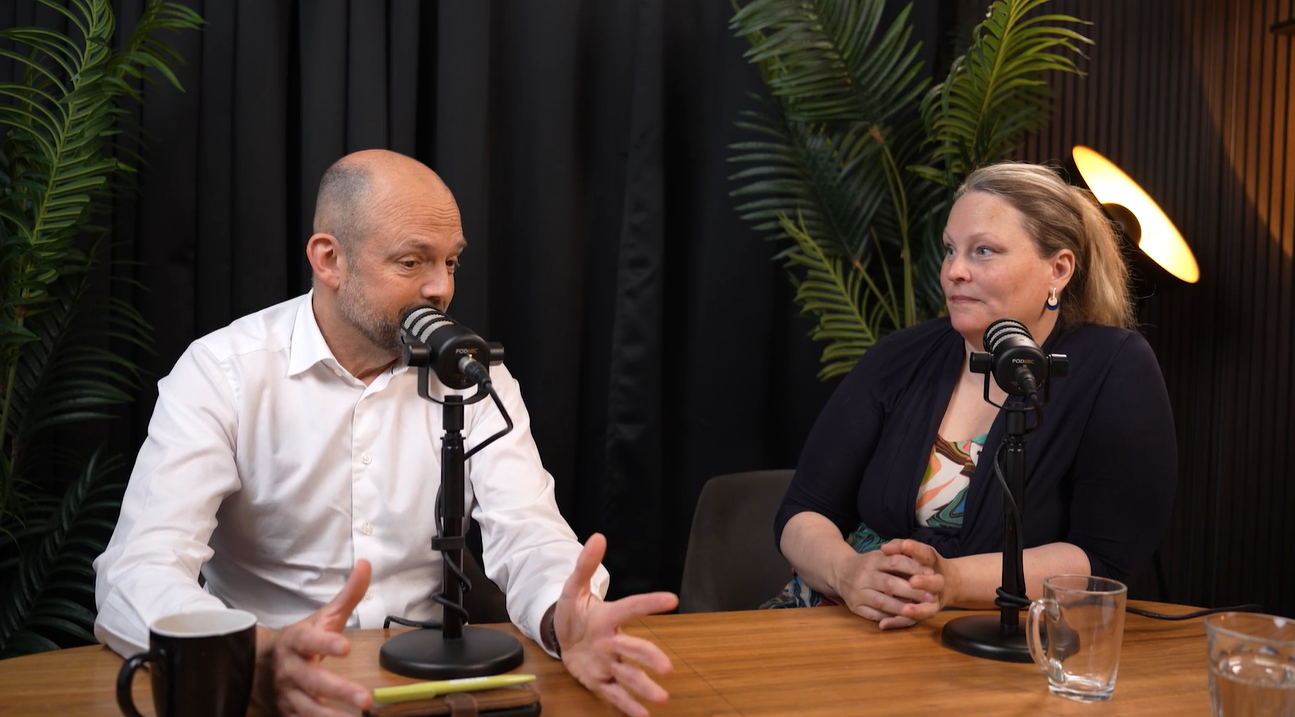
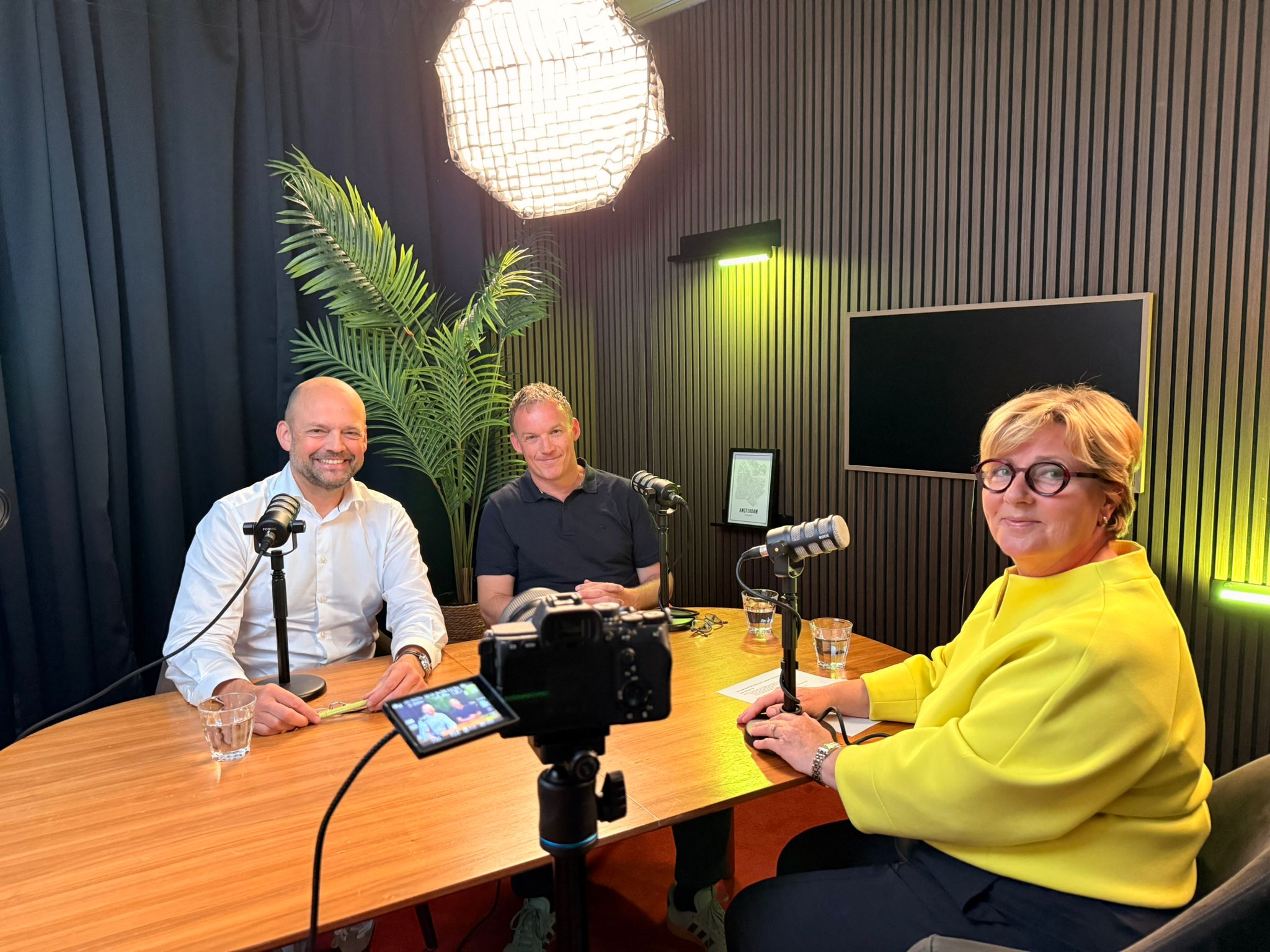
On the Product Owner Podcast from ProductOwner.nl, our CEO Jaap Merkus shares his vision on nearshoring, the power of stable development teams, and the role AI plays in developing better software. A conversation full of practical insights for anyone considering software development through nearshoring or wanting to understand how AI is actually changing the development process.
In his weekly podcast, Jochem Nuij welcomes interesting guests, such as entrepreneurs, product owners, and subject matter experts who share their knowledge and experiences. In his introduction, he was notably positive about NetRom Software: “Within our network, NetRom is the most stable nearshore partner, one that never causes any hassle.” That’s a nice compliment after six years of collaboration and a strong start to an interesting conversation.
Jaap Merkus: from programmer to CEO of NetRom
Jaap Merkus (56) studied in Delft and began his career in geophysical software development. He later built on his technical background by studying business administration at Nyenrode, after which he entered the consulting field and subsequently held international management roles at Philips in locations including the Middle East and England. The common thread throughout his career has been leading companies with 300 to 800 employees, where entrepreneurship takes center stage. “At that size, the organization isn’t so large that you spend the whole day in meetings, dealing with all sorts of layers and coordination,” Jaap explains.
From two entrepreneurs to 500 specialists
NetRom was founded 27 years ago by Han in ’t Veld of the Netherlands and Mircea Negrila of Romania. Both were drawn to entrepreneurship and chose to start a company for custom software. The focus was on clients from Western Europe, and that has never really changed.
Jaap emphasizes that it is precisely this consistency that has brought the company stability and growth: “Stick to what you know best. And we know what we’re good at: everyone in our company is passionate about software and coding.”
The company now has nearly 500 employees, of whom about 430 engineers workin Romania. About 70 percent of revenue comes from the Netherlands and Belgium (particularly Flanders). In addition, NetRom operates in seven countries, including Switzerland, Germany, and England. Its largest client is based in the United States, underscoring the company’s international character.
A family culture on its own campus
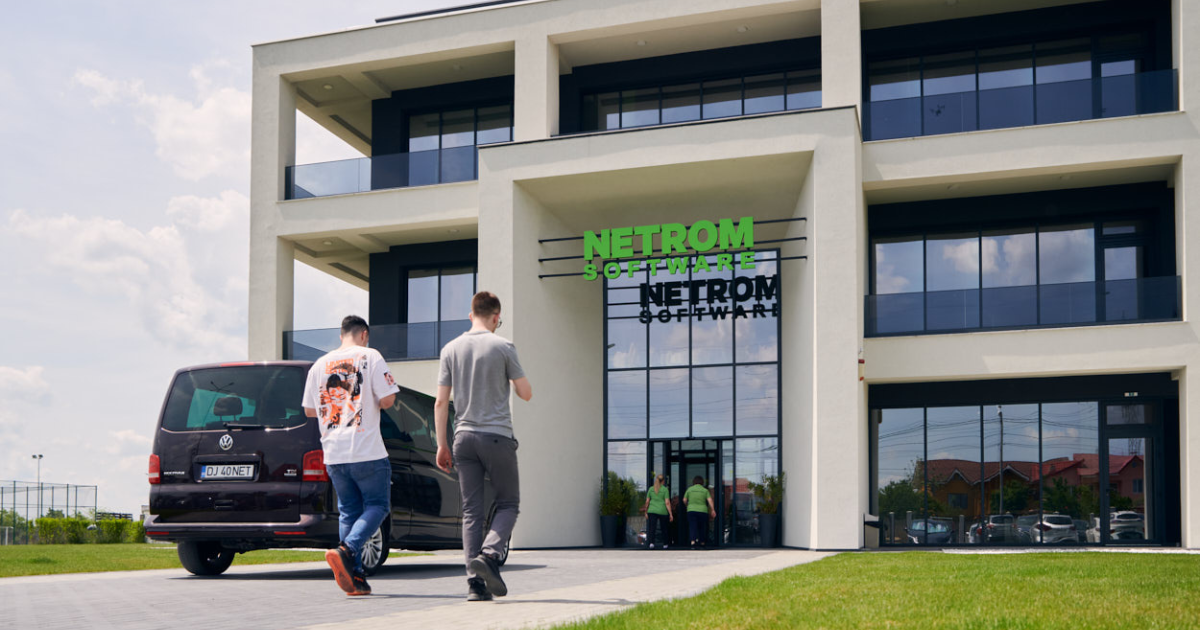
In Craiova stands the NetRom Campus, featuring extensive facilities, including a company cafeteria that is entirely self-managed. Jaap describes the atmosphere as a family culture where mutual support is second nature. If a team encounters a challenge, colleagues are immediately ready to pitch in. “We train people in this, but it’s almost second nature by now,” he says. “That culture of collaboration and proactivity is a key pillar of the quality we offer our clients.”
Stereotypes about nearshoring: time to dispel them
A key topic of discussion was the persistent prejudice that nearshoring is slower and that foreign teams are less proactive in contributing ideas. Jaap doesn’t recognize that image. Cultural differences exist, he acknowledges, but they can easily be bridged. Romania has only a one-hour time difference with the Netherlands, is a member of the European Union, and the IT specialists there speak excellent English.
Moreover, NetRom deliberately selects candidates based on more than just technical skills. “We recruit not only based on deep technical skills, but also on communication skills, such as active listening and team spirit,” Jaap explains. In his view, the idea that nearshoring teams don’t contribute ideas on their own is therefore a misconception. NetRom focuses on this from the very beginning: the Dutch, non-hierarchical way of working has been successfully integrated into the Romanian development teams through the example set by senior staff and targeted training. The result is that clients specifically appreciate the proactiveness of the NetRom developers.
Blended and dedicated: the power of “both-and”
When asked whether he prefers blended or dedicated teams, Jaap answers without hesitation: “No preference. We do 50-50.” NetRom prefers to start with a blended collaboration model, so the team can become thoroughly familiar with the client’s working methods, tools, and domain knowledge. “You want to get used to working together and fully understand the specific domain knowledge.” From that foundation, a team can then evolve into a dedicated setup, with a direct line to the client’s product owner.
What NetRom deliberately avoids is individual secondment. Jaap explains that a single remote developer becomes too isolated to function effectively over the long term. Stable teams are key, and that stability is there: some engineers have been working for the same client for six to eight years.
High speed is not a promise, but a requirement
Jaap is clear about his teams’ productivity: “I can say with certainty that we’re up and running faster than many Dutch teams.” That speed isn’t a side issue, but a core promise. In the first two months, NetRom continuously aligns velocity and quality with the client.
AI: part of our service offering for 15 years
The conversation covered the role of AI. Jaap puts this into perspective: NetRom has been working with machine learning algorithms for clients for about 15 years. That experience makes all the difference now AI integration becomes relevant for more and more organizations. SaaS companies in particular, which account for well over half of revenue, are requesting AI modules and AI agents in their products. Jaap points out that SaaS data is generally better structured than that of other organizations, allowing AI applications to deliver value more quickly.
Honest about the impact on productivity
Jaap takes a refreshingly down-to-earth view of AI-enabled development. All engineers now work with AI copilots, but the direct impact on productivity is more limited than is often assumed. The actual writing of code accounts for only 10 to 15 percent of development time. “A copilot that helps get the syntax right quickly - that’s 30 percent of 10 percent. That’s 3 percent,” he calculates. “The real gains lie elsewhere: in AI support for the thought process, automated code reviews, and company-specific agents that work with proprietary data.”
The productivity gains from AI are gradual, similar to the transition from waterfall to agile. “It’s not a huge leap,” Jaap concludes. “It happens one percent at a time.”
The future: over 430 engineers plus 100 virtual agents
When asked how the revenue model is evolving, Jaap outlines a future in which NetRom deploys not only its current team of over 430 engineers but also about 100 virtual AI agents, trained on the company’s own methodology. He is adamant about one thing, however: collective knowledge remains essential. “I don’t buy into the idea that the knowledge of exactly how a product works will eventually reside only in the minds of a handful of people and in AI agents. That’s far too vulnerable.” Risk management requires broad knowledge sharing within teams, supplemented by AI as a powerful support tool.
Curious about the full conversation?
You can listen to the full conversation between Jaap and Jochem on the Product Owner Podcast at productowner.nl or directly through YouTube below. Note: the podcast is fully in Dutch.
Are you curious about how our experienced and motivated development teams can help your organization with the integration of AI technology? Or would you like to learn more about how we use AI to tailor our development processes even better to our clients’ needs? Please contact us for a free consultation. We’d be happy to tell you more about our extensive capabilities.
Jaap Merkus: “Sometimes you have to slow down a bit, take a step back, and then take two steps forward”
Jaap Merkus: “Doing nothing about AI isn’t an option: you have to figure out what works for you” [DUTCH PODCAST]